Featured

Dad Devotional Day 33

Ben Franklin, a Pharisee, and God

Mark 12:13-17

It is Holy Week and my son and I are reading through Jesus’ life as He is preparing for His victory on cavalry. It has been fun and this morning, we read Mark 12:13-17 about the Imperial tax to Cesar and the trap of the Pharisees. 

Benjamin Franklin once said, “Our new Constitution is now established, everything seems to promise it will be durable; but, in this world, nothing is certain except death and taxes.” A certainty, which is as true today as it was two thousand years ago. Amazingly, as we approach Easter and Tax Day, these two realities are once again strange bedfellows. 

Picture in your mind the large courtyard of the Jerusalem temple.  There are various groups congregating around different teachers, each deeply engaged in discussion about religion, politics, or the world.  On one side are the Sadducees, teaching about strict interpretation of the Law handed down to Moses and incorporating Hellenism into the Jewish world.  On the other side of the yard are the Pharisees, teaching about the oral traditions of Moses and culturally very pro-Jewish.  Somewhere in the middle is a small group that caused a big disruption just a few days ago when they entered Jerusalem.  This group is surrounding the man called Jesus.   No one can figure out which side this guy is on, but He is causing much unwanted attention.

The pro-Jewish, Pharisees approach Jesus with a question designed to make Jesus choose a side.  They ask Him a simple question, “Should we pay taxes or not?” The question is effectively, which side are you on? Are you a pro-Jewish teacher or a pro-Roman teacher? Jesus’ answer is clear and deep.  He says, “Bring me a denarius and let me look at it.” They brought the coin, and he asked them, “Whose image is this? And whose inscription?” “Caesar’s,” they replied. Then Jesus said to them, “Give back to Caesar what is Caesar’s and to God what is God’s.” What a way to skirt out of that trap, but what does He really mean?

Well, the implications to paying our taxes is pretty clear.  But what about the whole “give to God” part?  The question is who is bearing the image of God just like the coin?  Well, we are in one respect.  We are created in His image and belong to Him as the creator.  This is beautiful and true, but it is incomplete. And this statement would not account for the amazement of the Pharisees.  Of all the people in the courtyard that day only one actually bears the full image of God, because He is God.  Jesus is claiming His image of God and telling them to recognize it.  Now this is something to be amazed at! 

This season as we prepare to pay our taxes, we must also prepare to pay to God what is God’s.  We are all in the courtyard and must make a choice as to which group we decide to stand with.  Are we pro-American, pro-spirituality, or are we pro-Christ. Choosing Christ is recognizing Him as payment for our sins, because God minted Him as the currency.  Ben Franklin’s truism reminds us that Easter is just as much a certainty as April 15.

Note: Yes Tax Day 2021 is extended to May 17, but I wrote the article before I found out. #dadlife

Featured

Easter Vigil and finding the Church

A small break from our current reading of Psalms and Proverbs to talk about Protestantism and Catholicism.

For the past year, Christ has been working in my heart leading me and my family to a fuller understanding of Scripture.  This process started with shaking my faith really hard.  It then led to looking for churches that were actually meeting in person, which in turn led to attending a Catholic Mass.  After few promptings by the Holy Spirit, I found myself in RCIA (Rite of Christian Initiation of Adults) and on my way to Confirmation this Easter.  It has been a journey and my son has been along for the ride.  We are learning new prayers and he is attending a new Catholic School.  It was a bit of a shock to my family, because I grew up as a Protestant attending a very good non-denominational Christian school. I decided to write this article to highlight misunderstandings between Catholics and Protestants and more importantly, to collect my reflections for my son. This is my novice Catholic rationale for some differences and why I am continuing to follow the road Christ led me to a year ago. 

God the Father gave all of His Son and His Son gave all of Himself

Two thousand years ago when Christ walked the Earth, it was a very different place.  This would not strike anyone as novel and my son would be prodding me here to move along with the lesson.  To the Jews of the day, the world was already very old. Abraham was alive two thousand years before Christ and Noah was about a thousand years before that.  The God of the Old Covenant was distant and removed from his people.  But He wanted His creation to know Him intimately and be His sons and daughters. 

This required a New Covenant in the full giving of Christ Jesus.  Christ then gave all of Himself for us to establish this New Covenant with God.  It was not only His virgin birth, not only His ministry, not only His death on the cross, everything He is, is bequeathed in this New Covenant.  This theology is essential to understanding the Catholic faith.  There is not one part of Christ withheld from His followers. Paul stresses this point in Rom. 8:17, Gal. 3:29, Gal. 4:7 and many more places.  From this full giving theology flow all of the teachings of the new Covenant. 

This idea of fullness or cohesiveness is pivotal when comparing Protestantism and Catholicism. Both theologies must be in line and conditioned on one unconditional truth, i.e. God.  To make this happen Protestantism omits key elements of Scripture to keep it logical, but theologically lacking.  When these elements are incorporated, the theology and practice of the faith looks a lot like the Catholic Church.  It is this fullness of understanding Catholic Church that led me to read Scripture in a new light.

Literally or Literarily

Admittedly English is a dumb language.  Our words can have double meanings and even when we use very precise phrases, they can still be misinterpreted.  So, when Christians say the Bible is true, it is still an ambiguous statement.  The universal Christian theology is founded on the sacredness of Scripture.  Anything more starts splitting Protestants and Catholics.  Many fundamentalist Protestants claim a literal interpretation, albeit with astricts all over the place.  C.S. Lewis, a lion of Protestant apologetics, clearly rejects literal fundamentalism in Reflection on the Psalms ch. XI. Here he states, “that every sentence of the Old Testament has historical scientific truth.” On the contrary, says Lewis, “[This] I do not hold, any more than St. Jerome did when he said that Moses described Creation ‘after the manner of a popular poet’ (as we should say, mythically) or than Calvin did when he doubted whether the story of Job were history or fiction.” Adherence to a literal interpretation is uncorroborated in Scripture itself and is not supported by major theologians. Therefore, any church teaching this would be inserting their own unscriptural theology.  What follows is that many of their teachings from the Scriptures would be potentially flawed. In order to form a sound argument Scripture is treated as a salad bar, picking and choosing verses. 

Catholicism has a long tradition teaching the Scriptures literarily.  This means just as we approach Shakespeare, Locke, or Plutarch; we should also approach the Scripture.  Asking critical questions and applying proper context is expected.  This is the teaching of the Catholic Church (CCC 109 & 119). Within this critical analysis must be a continuity of the whole body.  This makes complete sense and if you are like me, leads one to ask what happens when there is an interpretational disagreement?  This obvious question shows the problem with Sola Scriptura or Scripture Alone theology.  The Scripture itself recognized tradition as predating it (see 2 Thes. 2:15) and gave Peter authority over reconciling these disputes (see Matt. 16:19).  Christ knew there would be disputes between interpretations and taught His followers how to resolve them for example: ex cathedra, synods, and traditional teaching.  This logical and scriptural support for an arbiter leads to the question: is it the Catholic Church?

Mustard Seed and the oneness of his Church

We tend to romanticize Christ walking around with an intimate group of Apostles and a larger group of disciples. This leads many Protestants striving to recreate it today and model their churches after it.  I don’t begrudge them and on one level, this sense of intimacy with every Christians, is part of Heaven.  But this leads to many small disunited bands of believers rather than one church.  The Protestant view of The Church is a general collection of people who call themselves Christians and move in an anamorphous cultural blob.  One small church springs up here and another one dies out there. The goal seems to be similar the crab grass in my back yard, constantly spreading.

Pondering this, the parable of the mustard seed came up (see Matt. 13:31). Christ describes the Kingdom of Heaven (i.e. His Church) as the smallest of seeds, but grows up into the largest of trees.  Why after two thousand years, would Christians be looking for a young little sapling?  It should be a mighty, well established tree able to support the many demands of the world. Also, Eph. 4:3-6 stresses there should be one Church and one body.  If I am to call myself a faithful follower of Christ and the Scripture, how could I not take this verse very personally in a Protestant denomination? Webster defines denomination as a recognized autonomous branch of the Christian church. If Scripture teaches there should be one church, which one is it?

The obvious answer to me is that it is the one in existence following Christ’s crucifixion.  It is the one with all the scars of time and humanness of Christ’s suffering. It is the one which the Apostles themselves recognized (see Phil. 4:3). In 1 Clement (an early church letter), there is a brief anecdote that helps to show how the early church saw itself operating. Peter appoints Clement as a Bishop in Rome and when Peter is martyred, Clement becomes the head of the Church in Rome. A little while later, there is a dispute within the Church, and even though John the Apostle was still alive, they turn to Clement to adjudicate it.  The Church recognized Jesus’ words to Peter (see Matt. 16:16-19) as bestowing a unique authority, which he passed on to Clement.  The more I delved into the Gospels, the more Peter kept popping up.  Peter is the fisherman of men, Peter is there at the transfiguration, Peter denies Christ, and Christ commands Peter to tend His sheep.  Peter, Peter, Peter!

There is one more argument which is strong enough to include here.  Every time Christ refers to His Church, He calls it a Kingdom.  His tell Pilate, that He is indeed a king (see Jn. 18:37) and all over the scriptures He is called King.  If He is king, then wouldn’t it logically follow that His church would look like a kingdom?  Now I am a simple man and I am familiar with four forms of governments: republic, democracy, oligarchy, and autocracy.  Christ says that His Church is like the last one.  This means that if a church operates in any of the other way, it is by definition not operating as Christ commands it to operate.  Now, the Pope is not its king, Christ is King. Rather he is Vicar of Christ acting as His representative. A bad pope or a good pope is inconsequential to the argument.  All I need to know is Christ says kingdom, He says Peter, and the church fathers affirmed apostolic succession. 

Rejection of Church fathers but reverence for founding fathers

I suppose this is as good a place as any to put my next objection.  Why do American Protestants revere the founding fathers of our country, but reject the founding fathers of the church?  Much of Protestant theology is built upon the arguments of Polycarp, Irenaeus, Aquinas, Augustine, Ignatius, and more.  Do you believe in the trinity as one God, three persons?  What about Christ being 100% man and 100% God? What about presbyters and deacons in your church?  All of these good issues were established by church founding fathers.  But, most Protestant churches in America would not recognize any of these men as authoritative?

Let’s choose one as a good illustration.  Polycarp was the Bishop of Smyrna and lived 65-155 AD. Polycarp came to follow Christ and was instructed by John the Apostle and many others who had seen Christ.  He went on to refute heresies and his citations of scripture attributed to the canonization of the New Testament.  This guy is a huge founding father of the faith.  He is like James Monroe establishing the Monroe doctrine guiding our foreign policy for the first 100 years.  Protestant claiming the Scriptural authority of the Bible should at least submit to the teachings of the man who helped codify it. But Polycarp taught Irenaeus, who taught the perpetual virginity of Mary, and True Body of the Eucharist, and a bunch of other things Protestants don’t like so he could not possibly be right about those things

The hubris is almost unbearable.  Accusing a man who is effectively the spiritual grandson of Jesus Christ to be correct in his selection of scripture, while incorrect of his application of it and therefor relegated to the dunce corner is absurd.  Jesus did not give us the answer to all our questions, rather He gave the Holy Spirit leading men to speak authoritatively.  Being nearer to His teachings in time, certainly places the authority of the early church fathers over the teachings of any Protestant Reformer. 

This is my body & The Eucharist

In the Protestant Church, the Lords Supper can take many forms except one.  It can range from a general meal in a home to a formal ritual in a building.  The purpose is usually remembering Christ’s death for our sins.  It is thought of as a symbolic act setting Christians apart from non-believers.  It often is one of the only two traditions (baptism being the other,) a Protestant church actually performs.  But under no circumstances, no matter how fundamental, or literal the church claims to be will it ever be what Jesus Christ Himself says it is…

The Catholic Church refers to certain elements of the faith as ‘mysteries.’  By this, they mean there are parts of the theology, we could never figure out on our own.  For instance, no matter how hard theologians try they can never come to the conclusion that Jesus Christ is the Son of God and He died for our salvation without God actually revealing this to us.  In other words, you can’t logic your way to the cross.  During the Last Supper, Christ instituted a ritual with specific instructions “do this in remembrance of me” (see Lk. 22:19, 1 Cor. 11:23).  This is a command by Christ and He describes what is happening.  He tells the Apostles, “this is my body” and “this is my blood” (Matt. 14:22). The Catholic Church is wise enough to recognize that when the Son of God says, “this is my body” and “this is my blood” He means it.  We should believe Him and take it very seriously.  They recognize that it doesn’t taste or look like it, but somehow in God’s mysteries it truly is His body. 

I can’t logic my way to the Eucharist and that does bother me.  But I can’t logically figure out the cross either.  What does make logical sense is to listen to Christ’s words and believe them.  Christians should show the same appropriate reverence to the Eucharist as they would show to Christ body.  Through faith in Christ word’s, I can recognize the Eucharist as more than a tradition or symbol. It is Christ’s changing the essence of the bread and wine into Himself.  The saints of the early church clearly held this belief, which is one of the reasons they became Saints.

Saints and Mary

The amount of misinformation perpetuated among Protestantism in regard to Saints and Mary is voluminous.  Praying to saints, creating statues of them, and naming churches are all maligned as sacrilegious.  I was right there with them.  Like Saul persecuting what he did not understand.  But the Scripture has a basis for Saints.  There is so much of an argument for them, that I began to wonder on what basis is the argument against them?  Lest I be too cavalier in my criticism, I must acknowledge that humans have a tendency to abuse most everything. Assuredly, this is one of those cases where abuses in the past lead to continuing issues today. 

Have you ever asked a fellow Christian to pray for you?  If so, you never thought that were worshipping them, did you?  Nor should you.  We recognize that God wants our prayer all the time, every time. Asking a fellow Christian to pray for you is inviting them into your suffering to lay it before God. 

From this logical step, let’s look at three scriptural truths.  Christians are and will remain alive because of God’s grace.  Matt. 22:32 states, “I am the God of Abraham, the God of Isaac, and the God of Jacob. He is not the God of the dead, but of the living.”  In a real sense, the physically dead in Heaven are actually spiritually more alive than we are.  If then, we ask someone who is still struggling with spiritual death to pray for us, why would we not ask someone who is fully alive and with Christ to pray for us? The next truth comes from Paul who tells us, “Therefore, since we are surrounded by such a great cloud of witnesses, let us throw off everything that hinders and the sin that so easily entangles.” (see Heb. 12:1).  Paul tells us we are not alone in our struggles, angles and saints are here rooting for us.  The angels and Saints are part of our church family and including them in our prayers is recognizing all of Christ’s Church.  Lastly, in Rev. 5:8, “the four living creatures and the twenty-four elders fell down before the Lamb. Each one had a harp and they were holding golden bowls full of incense, which are the prayers of God’s people.” I know what you’re thinking, ‘don’t get all eschatological on me now.’  But hang with me, these twenty-four elders are Christians in Heaven presenting the prayers of saints (i.e. Christians here on Earth) to Christ.  This is part of the vocation of Saints in Heaven.  To me these are strong arguments to ask a Saint in Heaven to pray for you. 

Mary is special because she is the mother of God and Christ gave her to His church (see Jn. 19:25).  But more than that, by the time the Book of Revelations was written around 96 AD, Mary was widely recognized as the Mother of the Church.  For this reason, she appears in Revelations 12 with twelve stars on her crown.  The early church recognized this as the twelve tribes of the church adorning her head or rather the twelve tribes resting on hers.  There is much more to Marian doctrine, but the Catholic Church is correct to hold her in the highest esteem among all the Saints.

Salvation and Purgatory

Once saved always saved and the Luther maxim, “sin boldly” are classic phrases encompassing the core theology of Protestantism.  There is nothing that can separate us from the love of God and from this kernel Luther made the leap saying, “No sin can separate us from Him, even if we were to kill or commit adultery thousands of times each day.” Christ blood does cover all sins, but if you really lived out Luther’s argument, it would be hard to make the case that you are actually in Christ.  The person Luther is describing is a chronic murdering sexaholic.  There are many scripture verses refuting this, Rom. 6:1, 1 Jn. 3:6, Rom. 3:8, Gal. 2:17, Jer. 4:14, and Rev. 22:11 just to name a few.  Protestants tend accuse Catholics of claiming the saving grace of the cross is not enough. But this is far from the truth.

The Catholic Church agrees the saving grace of the cross is sufficient to cover all sins, but there is more to it.  The Bible speaks of salvation in three different tenses; past, present, and future. Because this is how Scripture approaches salvation it is how the Catholic Church does. 

Past. Christ’s victory on the cross is final and accomplished.  He will never die on the cross again nor are Catholics re-crucifying Him every Sunday.  Catholics affirm 1 Pet. 3:18, “For Christ also suffered once for sins, the righteous for the unrighteous, to bring you to God. He was put to death in the body but made alive in the Spirit.” Acknowledging this victory and submitting to His authority is the first step to salvation. 

Present. Christians colloquially use the phrase, “you will know them by their fruit”.  This means that if someone is sinning, they are not in Christ.  James very clearly argues the value of a righteous life in Jas. 2:14 “What good is it, my brothers, if someone says he has faith but does not have works? Can that faith save him?” Paul also supports this idea again and again in his writing, depicting our salvation as a race to be run to the end. 

Future. Though Christ died for us, we continually struggle with sin day in and day out.  The Bible teaches us that there is an expectation of our perfection (see Rom. 13:11).  Some day in our future, we will have a judgement and we will be completely saved.  When that day comes our salvation will be complete. 

Then there is a small little thing that Protestants have a hard time understanding, Purgatory.  Honestly, this objection I don’t totally understand why there is a big problem with this theology.  We are sinful and have sin in us.  We have a natural tendency to sin and this needs to be fixed before we enter Heaven.  Scripture even teaches, “no unclean thing shall enter heaven” (Rev. 21:27). Purgatory is the scrubbing clean of all our sins by Christ’s cleansing fire (see 1 Cor. 3:12-15).  Does it hurt, I don’t know, probably.  I’ve been sinning my whole life, so it makes sense that it’s unpleasant.  If I have more of a tendency to sin, it also makes sense this process might take a bit longer.  The point is we all are sitting around in our filth and need a bath before we can go to the party.  It is not punishment for our sins, rather it is Christ’s love actually washing them off of us. 

True Church or Full Church

Protestants can be very territorial and start claiming all kinds of ‘true this’ and ‘true that’.  They build churches right next to each other and start all kind of arguments. It is good to have debate, but it is not good to divide a church because one pastor teaches infant baptism and another adult.  One church wants to celebrate the Eucharist reverently and another wants to have a rock band.  This article has been focused on theology and that’s where I am going to keep it.  There are many churches teaching theological truths and certainly have strong Christ followers.  But there is only one church striving to include all of the Scripture and tradition to the fullest.

This is the stance of the Catholic Church.  In the most recent Vatican Council II, the Catholic Church went way out its way in to stress it does not claim to be the true church.  The Catholic Church affirms Scripture referencing many coming from afar to sit at the table of Christ (see Matt. 8:11).  Also, Jesus’ teaches the Apostles about others preaching his word (see Lk. 9:50). What the Catholic Church does claim is to be is the fullest embodiment of Christ’s Church.  And it does not claim to be perfect.  It is the first to recognize its flaws and again cites scripture, pointing out that even Judas was counted as one of the Apostles.  Despite all its flaws, it is scriptural, Apostolic, Universal, One, and Holy.  All through my search, the Catholic Church’s theology is water tight just like the ship she claims to be. 

The beginning

I once had a coworker who would say, “If I’m wrong, I want to know”.  I loved his humility and truth seeking.  Without a doubt my thoughts here are incomplete and debatable. But the argument for Catholicism is stronger than Protestantism.  Protestantism removes elements to dilute the fullness of the Scripture and weaken the theology.  Catholicism fully wrestles with Scripture and does its best to be Christ’s Church here on Earth.  One more point in closing.  I approached this whole process through a search of theology, because anything else could be misleading.  We should not choose a faith based on music, art, eloquence, or any other personal preference. If the evidence leads me toward an uncomfortable and unfamiliar place, I must follow it.  If there are parts I personally may not like, the truth is, I must be wrong.

Featured

Dad Devotional Day 32

Fear of the Lord

Spring is near and early signs are already starting to show.  The trees have sprouted little green leaves and flower shoots are beginning to bud.  But for the past year especially, virtue signs have been springing up all around my neighborhood.  You would recognize them.  A little sign sprouting in a person’s yard letting the world know the family living here is “woke.”  One of my favorites is “Hate has no Home Here”, usually adorned with a Marxist fist, a rainbow flag, and a peace sign.  The biddable mind which planted this sign, begs the question: Is there really nothing they hate?

Surely, some things are good to hate.  I hate cancer, tornados, war, and even eggplant. The list goes on and on.  Are we so far apart in our views that we can’t even agree on hating something?  As a dad, trying to teach his son about the Scripture, the question is not to hate or don’t hate.  The question should be, “What to hate?” 

Reading through Proverbs, a consistent phrase keeps hitting me day in and day out: the Fear of the Lord.  Here is a partial list of the times it shows up Proverbs 1:7, 1:29, 2:5, 3:7,14:2,26,27, 15:33, 19:23, 24:21, and 31:30.  An internet search of the scripture revealed 86 references!  This fear issue is clearly something that needs to be understood.  Now, I hate scary movies and my son is not a big fan of them either.  We are still trying to get him to watch Jurassic Park and he is not going for it.  So, I ask the question, is fear the same thing as fright? Let’s tackle this idea by looking at a different emotional spectrum, joy versus happiness.  This might be a bit easier to digest. 

Most can relate to happiness as a fleeting emotion.  Something great happens, therefore we are happy, but before long we return to our status quo.  Joy is different.  Joy is fuller and deeper than happiness.  It certainly encompasses happiness, but it is part of our sense of meaning in relation to creation.  The relationship between fright and fear is the same.  We may be frightened and this is an emotional response, but fear is a deep sense of our relation to something.  Fear is approaching something with extreme care, because it can very quickly turn to fright and worse.  With this in mind, let’s look at Fear of the Lord.

Fear of the Lord is such an ambiguous term that the Bible tries to clearly spells it out in Proverbs 8:13, “Fear of the Lord is hatred of evil”.  Thus, hating evil ought to be our basic orientation when we approaching God.  Now before you start playing Bible ping-pong and citing Proverbs 10:12, “Hatred stirs up disputes, but love covers all offense.” or 15:17 “Better a small serving of vegetables with love than a fattened calf with hatred.” Think about what you’re in essence defending, i.e. hating evil. Proverbs 6:16-19 even lists seven things God Himself hates. 

The problem with putting an inane sign in your yard is that a sign has already been put up for you.  A sign, which is accurately puts hate in its proper place.  Christ carried this sign willingly upon His body and then nailed Himself to it.  With a slight twist, which I do not think improper, I could argue that ‘For God so [hated evil] that He gave His one and only Son’ (John 3:16).  If ‘no hate’ lives in your home, then you welcome in everything and that by definition includes evil.  Teaching children to hate evil should be something we can all agree on.  But as for my son, I’m sure going to try to put the fear of God into him.

Featured

Dad Devotional Day 31

Riddles

What has roots as nobody sees,

Is taller than trees,

Up, up it goes,

And yet never grows?

J.R.R. Tolkien’s The Hobbit

Things said plainly should plainly be left unsaid.  As my son and I are reading Psalms and Proverbs in tandem, the artistry of the word flows over our breakfast table every morning. It is remarkable reflecting on the amount of time taken to compose and collect all of the verses.  The author could have plainly written God’s truths in a simple manner, which everyone could easily understand and comprehended.  Instead, the author chose to decorate and embed them in poetic riddles. 

This morning, as we read through Psalms 111, I highlighted an easy verse, “Great are the works of the Lord, studied by all who delight in them”.  Following it up with my usually dad question, “What does this mean?” The joys of fatherhood are numerous, but the perspective of a son’s answer is high on the list.  “You poke it.” He says and I laugh.  But, in a profound way he is not wrong.  When a boy walks through the world and stumbles across something weird, the first thing he does is grab a stick and poke it.  He wants to know what is it, is it alive or dead, is it useful or not?  He only pokes things which spark his interest and bring him delight.

In the same way this is what we do with Psalms?    On the surface some of the Psalms make sense, but the author does not keep it that simple.  He wants us to poke and test the work. Take for instance Psalms 110:1, “The Lord says to my lord: ‘Sit at my right hand, while I make your enemies your footstool’”.  What is this getting at? This Psalm seems like a scribe is recording God’s blessing on King David.  Christians read this verse and Matthew 22:44 should come to mind, as Christ cited it in regards to His own divinity.  Jesus ascribes these words to King David himself, illuminating a completely new truth.  Both of these interpretations are mutually true.  But think how many centuries went by before this single verse claimed its deepest meaning.  Glossing over Psalms misses its incredible artistry. 

The words of the scripture are to be engaged with.  We should poke them, test them, and engage in their riddles.  If we do this, then we welcome the Holy Spirit in our studies.  If we merely read Psalms and move on with our lives, what difference has it made reading it.  This is not to say that truth in the Scripture is only buried in riddles, rather that it speaks on many levels of truth.  As the venerable St. Augustine wrote, “The Bible is shallow enough for a child not to drown, yet deep enough for an elephant to swim.”

Did you get the riddle?  A mountain.

Featured

Dad Devotional Day 30

Wandering in Darkness

The Book of Job

There are great dads, there are bad dads, and then there are all of us.  We try our best to read the Bible, take our family to church, and not lose our temper the rest of the time.  I knew this journey reading through the Bible would eventually lead my son and me into the valley of Job. And I would have to navigate our way through the oldest book of the Bible.  Honestly, just between you and me. This scared the crap out of me.  Not because of the heavy subject matter or God throwing down a divine gauntlet, but because there are 41 chapters of which 38 are confusing ancient poetry.  If “all Scripture is God-breathed and is useful for teaching, rebuking, correcting and training in righteousness” (2 Tim 3:16); He ate some rank garlic before He spoke this one. 

A bit of background may help to put us all on the same page.  The book of Job opens in a land far away with a very righteous and successful man.  He has a large family and is so God fearing, he even offers sacrifices just-in-case his children sin and offend God.  Then one day in Heaven, as all the angels and God are hanging out; in walks Satan and God starts bragging about this guy Job.  Undeterred, Satan says, “Sure, he worships you; he has a good life and big family!” God tells Satan to take it all away and the game is on.  Stripped of everything except his health and wife, Job still remains faithful.  The next time Satan shows up in Heaven, God basically yells, “Scoreboard!” Satan replies, “Yeah, but he still has his health.”  Which leads to Job sitting in dirt, covered in boils, wondering what he did to deserve this.  The following 38 chapters of the book, Job argues back and forth with his three friends about his innocence until God finally appears in a thunderstorm.  God tells Job, “I’m God and you’re not.” and then restores all of his possessions.  The End. 

This is the story that most people know, but my son and I are planning on spending a month reading through all the stuff in the middle.  Discussing my fears with my brother-in-law, he pointed out that sometimes the process is the purpose.  With this in mind, my son and I plunged into the confusingly dark world of Job.  Many mornings we would read a chapter, grasping for the slightest bit of understanding.  Sometimes, when it seemed to make sense, the next chapter would throw us back into confusion.  It went on like this for thirty days.  “Am I wasting our time? Is this kid even getting anything? Maybe I could fast forward to the end?” I asked myself.  My only hope lay in finishing it someday and God providing a lesson through all this pain. 

About half way through, I began to reflect on my role as a father.  What gives a father’s words value?  Sure, I am older.  I have seen more of life.  And presumably, I love my son more than anyone else.  But why should he listen?  Then, the point of Job’s story struck me.  The currency of a father are his actions.  My words only have value when my actions impart them value.  Each day that we sat there struggling is a day that I lived out fortitude.

In a beautiful way, even though we sat there together in our confusion, we were not alone.  We were sitting with Job in his confusion, wondering what in the world God is doing?  I cannot tell you about the debates between Job and his friends or any deep theological truths.  All I can say is that the three of us sat there together looking for God.

Being a dad is not about providing top schooling or telling your son to go to church on Sundays.  It is about continuing to learn and lean into Christ myself.  Only because of my own actions should my son listen and follow my instructions.  Which is exactly why Christians call God our “Father”.  He descended from his seat in Heaven to become man. He acted out His ministry, died on a cross and gave His words eternal value

Featured

Dad Devotional Day 29

A Holiday to Remember

Esther Part 2

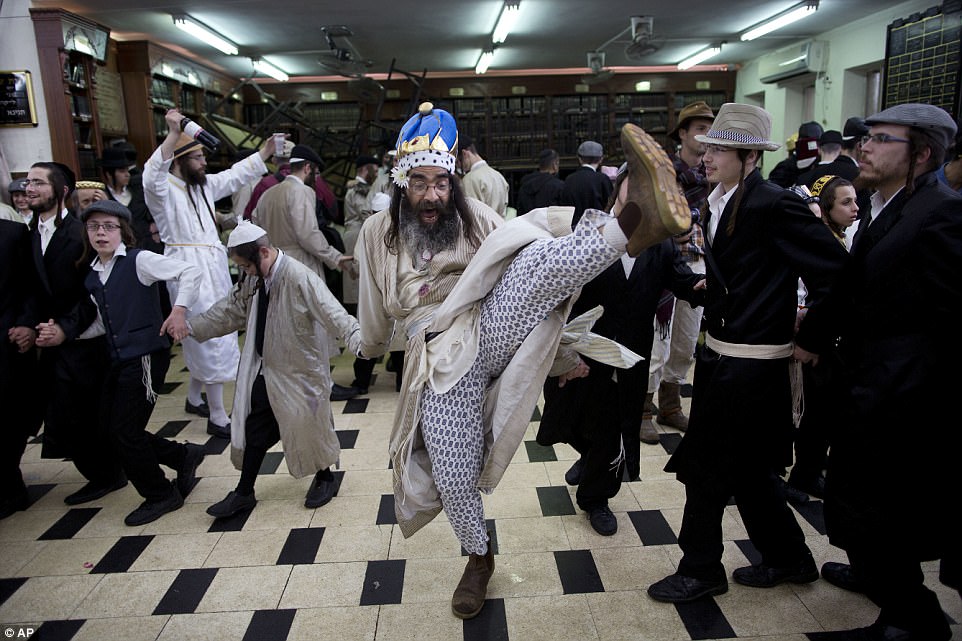
Of all the holidays recognized in the Bible, the Festival of Purim stands out as particularly bizarre.  It is still celebrated today by our Jewish brothers and sisters, but it is a combination of St. Patrick’s Day, Mardi Gras and Halloween.  Which is something all American Christians can relate to.  But, the origination of Purim is to celebrate the death of a Persian official, along with his ten sons, and 75,000 Persians.  At this point, most sane people would give pause and ask if this is really the kind of story we want to remember. 

I argue that it is, but not for any of the reasons above.  If we dig deeper into the story there are layers, which can be missed and are ultimately what makes this story of the Bible worth remembering. 

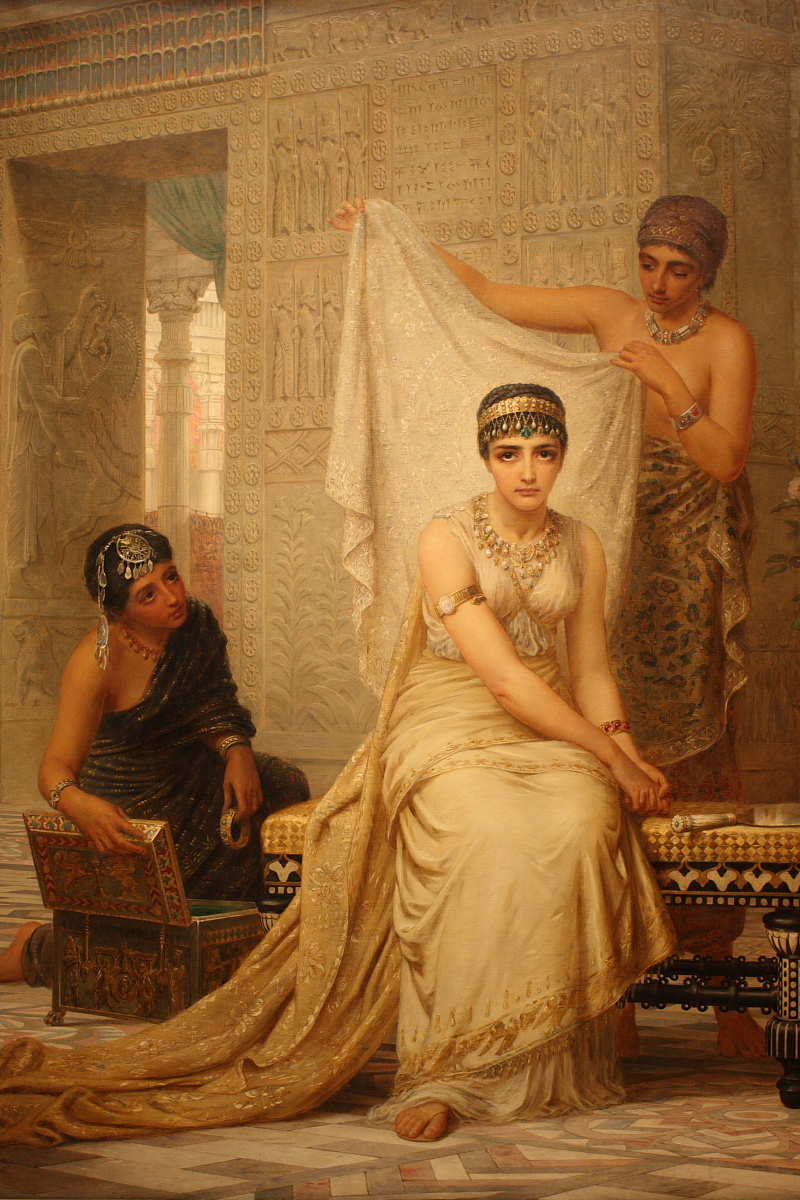
Last we left our Queen Esther, she was stuck in a marriage to the king and her uncle was facing the wrath of Haman, due to insubordination.  In response to this insubordination, Haman plans to impale Mordecai and manipulates the king into ordering an ancient version of the Nazi’s Kristallnacht.  Through a series of twists and outmaneuvering, Esther ends up convincing the King to put Haman on the stick instead and issue a counter law for the Jews to kill the Persians.  In fact, this first day of attacks successfully killed so many Persians, the King issues another law be continuing the assault the following day.  The event becomes “a day which the Jews obtained rest from their enemies and the month which was turned for them from sorrow into joy, from mourning into celebration.” (9:22) 

Can you picture what is going on here?  The Persian king issues a law to kill his Persian official and then for his second-class citizens to murder the first-class citizens in his empire.  This kingdom has seemed to turn itself completely upside down and lost its mind.  But despite this kingdom’s insanity, it somehow managed to build a Persian Empire stretching from Egypt and Turkey to India. 

If we are to understand this story, we must look at it like our tall tales in American history.  Think of Paul Bunyan, John Henry, Jonny Appleseed, and Betsy Ross.  Each other these people are used to tell a tale communicating truths us as a culture in a beautifully colored history.  The story of Esther is a Jewish version of a tall tale, but what is it telling us? 

In 1 Corinthians 3:19, St. Paul writes, “For the wisdom of this world is foolishness with God. For it is written, He taketh the wise in their own craftiness.”  The Jewish faith is a faith of laws handed down by God for the sanctification of His people.  There is nothing more sacred than these commandments.  Esther is a story of law against law.  Not people against people.  It is a story which shows the insanity of human laws to a people guided by God’s law. 

It can be hard to find ways to relate the Old Testament today.  But here is a story many of us should relate to.  We live in a country that murders over 800,000 unborn children each year, civil rights have become synonymous with political correctness, and legal marriage is being redefined.  Purim should be celebrated and remembered, but not because of the deaths.  It should be remembered because it celebrates the wisdom of the world for what it is…insanity. 


For those interested in an expert opinion relating to Esther and law, take the time to read Craig A. Stern’s Megillath Esther and the Rule of Law: Disobedience and Obligation. As a professor, Regent University School of Law, he is eminently more qualified than I and the paper is very interesting.

Stern_02 (2).pdf (lawandreligion.com)

Featured

Dad Devotional Day 28

Esther Part 1

“The savage [said] defiantly, I’m claiming the right to be unhappy’ ‘Not to mention the right to grow old and ugly and impotent; the right to have syphilis and cancer; the right to have too little to eat, the right to be lousy; the right to live in constant apprehension of what may happen tomorrow; the right to catch typhoid; the right to be tortured by unspeakable pains of every kind.’” Adolphus Huxley Brave New World

Suffering is rapidly becoming a foul word today.  Christians and atheist alike both view any suffering as a wrong apart from God’s will in the former or a failure of human progress in the latter.  An illness is feared and avoided to the point we are willing to sacrifice relationships in order to avoid it.  We put smart sensors all over our homes and bodies just to avoid minor unpleasantries.  If we cannot train ourselves to endure and grow in small trials, what chance will we have enduring real suffering when it comes?

If civil liberties are violated, immediately Americans stand up and scream for their rights.  Sometime this may be called for, but at other times, suffering injustice is exactly what we are supposed to do.  This statement is heretical to modern minds, but it should not be to the Christ follower.  How are we to know when we are being called to suffer or when we are called to stand against oppression. 

The Old Testament book of Esther exemplifies the choice to acquiesce or defy suffering.  In the story, a tyrannical Persian king seeks a new queen by gathering all the beautiful virgins of his kingdom and sleeping with each one until he finds his favorite.  A young Jewish girl, Hadassah is being raised by her uncle, Mordecai, and is caught up in this sexual dragnet.  In order to protect her ethnic origins, her uncle instructs her to go by the pseudonym Esther, and suffer the tyranny of sexual enslavement under the foreign king.  Esther is selected to become the new queen and married to her people’s oppressor.  Her suffering is unimaginable. 

As Esther is going through her ordeal, her Uncle Mordecai, is also challenged.  The kingdom’s law proscribed all would bow to the king’s second-in-command, Haman.  But Uncle Mordecai who has been standing watch at the palace gates refuses to kneel before Haman when he parades out.  He will not bow before any man or god other than God Himself.  Haman’s pride enflames his anger against the Jews because of Mordecai’s insubordination and he is determined to seek revenge. 

I will continue on with the details of this story next week, but these comparisons between Esther and Mordecai are striking.  On one hand, a young woman is stripped of her ethnic identity, forced into sexual enslavement, and married to her people’s enemy.  She submits to all of these injustices without any objection.  But when her uncle is confronted with simply bowing before a royal official, he refuses.  It would certainly seem that Esther has the greater right to objection than Mordecai does.  But this story reveals a different truth. 

Looking at this story through the lens of Jesus, we understand suffering tribulations in a clearer light.  Jesus says in Luke 9:23 “Whoever wants to be my disciple must deny themselves and take up their cross daily and follow me.” Likewise, St.Paul quotes Psalms 44:22 when he says to the Christians in Rome “Yet for your sake we face death all day long; we are considered as sheep to be slaughtered.” (Romans 8:36).  Christ makes no defense to suffering.  In his words and his actions suffering is a taken for granted.  Christ even makes denying our own desires and suffering a prerequisite to being a disciple of his.  This is not a call to go out and look for ways to suffer, but when it comes, it is certainly not supposed to be cured like a disease.  Esther is the embodiment of this message and her patient suffering is in Christ model. 

On the other side of the argument.  There are times we cannot bend to the will of others.  When asked what is the greatest commandment, Christ quotes Deuteronomy 6:5 “Love the Lord your God with all your heart and with all your soul and with all your strength.” ‘Loving the Lord your God’ means never putting false ideas of the world before Him.  We are to place His commands before all others.  Mordecai could not bow to Haman without violating the greatest of God’s commandments. 

What does this all mean to us?  It means everything!  When Christians are facing challenges and dilemmas, we must ask ourselves, which of these two paths are we going to take?  The choice may seem hard, but this actually simplifies our choice.  If our bodies, culture, or anything aside from the spiritual bending of our soul to God, we must embrace the suffering for Christ sake.  But, if the world commands us to accept moral perversions, political dogmas, and social activism we must reject them for Christ.  By this we Christians claim the right to suffer with Christ. 

Featured

Dad Devotional Day 27

Judith

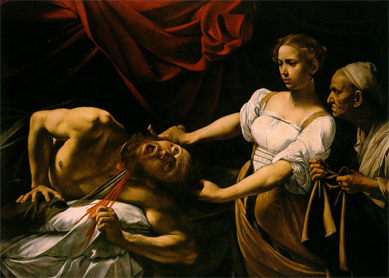
My son and I are reading the story of Judith.  This short novella is famous from the many paintings and sculptures of the beautiful heroine depicted in the act of cutting off the villain’s head or triumphantly carrying her trophy.  The wonderful story begins in a little mountain town on the outskirts of Israel standing against the undefeated Assyrian army.  As their food and water supplies dwindle, so too does the people’s hope, and they convince their city leaders to capitulate in five days.  Into this scene, a beautiful rich widow contrives a scheme to rescue the town and save the rest of Israel. 

Leaving the town, she descends to the encamped army in her “going out clothes” looking for the man in charge.  She tells a bold face lie to the Assyrian general about her defection, desire to aid his army, and begins seducing him.  On the night when the general plans to “ahem,” Judith removes his sword and cuts off his head while he is passed out drunk.  The rest of the story is boiler plate murdered armies and victorious Israel.  Wonderful children’s story, thanks, Bible

We are not the kind of family which typically has issues discussing sex and bloodshed in the Bible.  These elements are part of our human story.  But what about the bold-faced lie and deception?  What about violating number eight (false witness) and number five (murder) of the Ten Commandments?  How do I lionize this heroine in light of her deceit?

Lest, I castigate Judith alone, there are many examples of females lying to save lives in the Bible.  Sarah lies to Pharaoh about her marriage, the Hebrew midwives deceive the Egyptians about birthing male children, and Rahab lies to protect spies in Jericho just to name a few.  Each of these stories has a clear life and death consequence to telling the truth and each time life takes precedence.  Which is a great lesson to learn when Nazi’s SS bangs on the door asking if we are hiding Jews in the attic?  But maybe something is going on here and maybe a lifeline to fathers seeking to instill Christian values in their children. 

This search brings us to a key question: What to do when a choice must be made between two sins?  Lie and murder to save life or tell the truth and be an accomplice to murder.  This conflict is a clashing spark that illuminates the darkness of our understanding.  The world is a muddy place and as comfortable as black and white moral questions are, there is a vast spectrum of greyness we live in.

Christ arrived into a world struggling to answer this question.  The religious leaders elevated the Law to God status while the disciples faced the danger of disregarding law all together.  Both approaches are logical opposites of the same fallacy.  Christ tells us in Matthew 5:17, “Do not think that I have come to abolish the law or the prophets. I have come not to abolish but to fulfill.”  Christ is inserting himself right in the middle between His followers and the scripture.  We must place all of the scripture in its proper place relative to Christ.  Only then can we actually have, “righteousness [that] surpasses that of the scribes and Pharisees, [and] enter into the kingdom of heaven” (v.20).  

Christ does not free us from obligations to follow the scripture, but the scripture only makes sense when we look at it in entirely with Him.  Judith is a heroine, because she understood that the Ten Commandments show us God more clearly, but they are not God.

Is Judith a children’s story? That’s up to you to decide, but where else can you read about war, lying, seduction, and murder and it only makes sense because of Jesus?  And that is the essence of a children’s story.  Thanks, Bible.

Featured

The Election

The problem is that Christ uttered the words, “render to Cesar what is Cesar and to God what it God’s”.  These words have plagued Christians for millennia.  We love Christ and have yet also have strong political beliefs.  If we had to choose, we would obviously choose Christ first.  Donald Trump is a good president and I support him by voting for him in the ballot box, but I also care passionately about my neighbors.  They have rainbow flags in their front yard and Black Lives Matter stickers on their car.  I cannot discount my obligation to them in Christ.  What am I to do?

I am 37 years old and would venture to say that most Christ followers between the age of 25-45 grew up in families who had a strong connection between Christ and politics.  The pro-life movement to Israeli nationalism have all been a part of my upbringing.  From these experiences, I have learned harnessing the Holy Spirit to a political movement tends to corrupt the former without blessing the latter.  Claiming God’s hand in current politics is marketing and pride in the worst extreme.  Knowing that my neighbors will look at a political sign in my front yard as an impediment to know Christ, I refrain from posting one.

I do think that the Republican party is better for our country and it stems from my deep beliefs in free will, free markets, and constitutionalism.  But at the end of the day I really don’t care.  I care about Christ, my family, and my community.  And this is my order of importance. 

If you take God and Christ out from the equation, the state and its rules take the place of precedence.  Many on the progressive side of the ballot do believe in Christ and our common bond is stronger than any political divide.  But there is a large majority who do not.  The progressive movement is strongly anti-god.  For this reason, winning at the ballot box is of paramount importance and why rioting is a response to loss.  The state has become a god worth fighting for. 

In this environment, I grow up looking to make peace with my neighbor.  I desire to win them to the true God of creation and show them that the false god of politics is a lie.  Vote for whomever you desire, but know that it is inconsequential to the real truth of our lives.  Christ came, lived, died, and lives again for you to have life in the fullest.  I choose not to have a Trump sign in my yard, because I care about you more than I care about Trump.  I choose to not to put my full political beliefs on display, because this is not my real flag.  I choose to lose an election because in my loss, you are my gain. 

There are many injustices in this world, but Christ did not seek to right any of them.  He came and did not address the racial injustices between the Jews and Samaritans.  He did not address the political injustices of Rome against the Israelites.  Nor did He address the slavery rampant in the culture.  He did seek to redeem the hearts of men and call them to live a life full of the law and His grace on the cross. So, vote for whomever you like, but do not begrudge the man who votes differently from you.  Do not let politics divide the body of Christ.  And do not let it divide our country.  

We are one country by the blood of thousands of men.  We are a great nation because this grand experiment is still functioning without the shedding more blood.  That is a miracle and that should be celebrated every four years.  The hand of God is on our nation.  We know that because we are able to peacefully transfer power every four years and we do not worry about taking up arms against my neighbor.  Can we finally see our founding fathers as men who did indeed have wisdom and foresight? Our system of government is rapidly becoming the longest continuing form of government in our world today. 

In closing, let us look to the election and ask Christ, “Teacher, which is the greatest commandment in the Law?’  Jesus replied: ‘Love the Lord your God with all your heart and with all your soul and with all your mind.’ This is the first and greatest commandment. And the second is like it: ‘Love your neighbor as yourself.’  All the Law and the Prophets hang on these two commandments” (Matt 22:36-40). 

Featured

Dad Devotional Day 26

A Brief Interlude

Back in My Day…

It always bothers me when someone accuses the culture of sliding.  The classic expression, “kids these days don’t know what it’s like” is followed up with the joke “back in my day…”  Who thinks like that?  No, that is not a rhetorical question.  Really, who thinks like that?  Seriously voicing these thoughts, means abdicating responsibility for today.  It shows a casual neglect for today’s struggles because of an unwillingness to identify with them.  And it shows pride viewing past struggles as greater.  The core problem is a lack of generational focus.  If older generations are leading the younger toward something, there is no us and them, it is we.  We are living today and facing our challenges together.  ‘All of this is well and good’ you say, ‘but what can we do about it?’

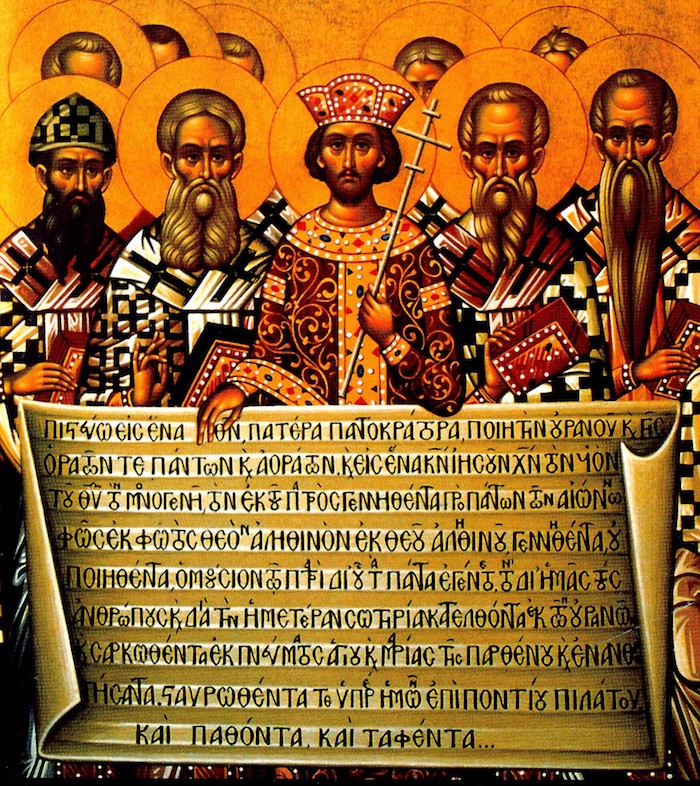
For centuries, Christians used a tool which needs to be reaffirmed, creeds.  Creeds are still present in many places; military, medicine, scouts and Christians all have creeds.  A creed is generational heritage focusing future minds.  The Apostles Creed receives its name from a legend, where the Apostles themselves formed it following Pentecost.  The Nicene Creed dates to 325 and addresses deep debates within the church at that time.  Learning a Creed unites our generation with the struggles our forefathers faced while giving future generations a cause. 

The Nicene Creed begins, “We believe in one God, the father, the almighty, the maker of heaven and earth, of all that is, seen and unseen.”  This one line unifies families and communities to move in a common direction.  The pronoun, we, is unique from the Apostles Creed’s I, which changes the focus from ourselves to that of the group.  American individualism is under attack by the use of this word.  Our children must know that it is not about them, but they are a part of a faith with considerable higher importance.  It continues, “One God, the Father, the Almighty” tripling down on who God is. This separates Christians from Atheist, Hindus, Buddhist, Nihilist, Agnostics, and Feminist.  The ending of the phrase affirms God is maker of all.  He is not in us, nor is there a ‘spark of divinity’ in everything.  God is the maker and is no more in humans than a painter is in his painting.  These are controversial ideas today.  But they were controversial when they were first spoken.  Indeed, that is why they had to be and should be.

One last thing.  A creed is not an argument.  There is no debating done in a creed and it is not going to win converts with blunt statements.  A creed is the result of wrestling with issues and ideas.  It is the trophy for days spent critically asking questions.  To this effect, having children memorize the words alone leaves them unable to bear the burden of apologetics.  It is like giving a participation award for playing soccer.  They did not earn anything and will lose the game when challenged by a better team.  Our children must learn why we use these words in addition to what they are.

The current generation is different from the previous one. But this could be said for every generation that has ever been.  The sun that rises tomorrow does not bring forth the same light that shone on the Earth yesterday.  But it traveled on a similar path and does the like work that the previous day’s light did.  It is our job to engage and put the minds of our children to work on correct issues.  Creeds are the best tool for families to grow together toward one common purpose in Christ.

At least that’s how we did it back in my day…

Featured

Dad Devotional Day 25

Ask Him, He is of Age

John 9

Recently my son celebrated his eleventh birthday.  He is maturing into a strong young man and I wanted to share a message from the scripture with him.  My mind blanked as I began to thumb through the pages searching for anything that stood out.  I stumbled across a story of a young blind man, who Jesus heals with spit and dirt.  As the story unfolded, it had enough pieces that I felt there was something to relate to our only child.  There is the young man, his parents, Jesus, and some antagonists.  Beyond that, I really did not have any idea what I was going to talk about.  But that is nothing new and the Holy Spirit has a way of giving dads something of value to relate.  This one proved to be a gem. 

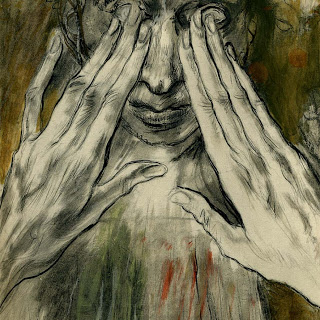
One day the disciples are walking with Jesus when they see a blind man and raise the question of sin.  The disciples want to know if the man or his parents sin caused his blindness.  Jesus responds with “Neither he nor his parents sinned; it is so that the works of God might be made visible to him” (v 3). Spitting on the dirt, Jesus then wipes the mud on the man’s eyes and tells him to wash it off.  The young man regains his sight and shortly thereafter, finds himself dragged before the leading Jewish council for questioning.  Refusing to believe his story, they bring in his parents as well.  Cowering in front of the leaders, the parents respond with “Ask him, he is of age”.  The young man is on his own. 

The Jewish leaders claim the man is lying and accuse him of colluding with Jesus.  His final response is a strong testimony to his moral character.  The man answers, “This is what is so amazing, that you do not know where He [Jesus] is from, yet He opened my eyes. We know that God does not listen to sinners, but if one is devout and does his will, he listens to him. It is unheard of that anyone ever opened the eyes of a person born blind.  If this man were not from God, he would not be able to do anything.” (vs 30-33).  It’s striking that his logic is so bold when compared to his parents. They shrunk in front of the leadership, while his commitment to truth is courageous. 

After reading this story to my son, I had to confess the words the Holy Spirit put in my mouth.  His mother and I are not going to be the unshakable icons of his youth.  We will make mistakes and he is going to have to make a stand on his own.  God will use my son’s life to work his mission and he must decide on whom to place credit. When this happens, it is going to be uncomfortable. Like Christ rubbing mud on the eyes of the young man in the story, my son will be blind to what God is doing in his life until after the trial and Christ reveals his sight.

What we want for our children reveals much about our relationship with Christ.  Do we want our children to be safe, wealthy, happy, successful?  If we call Jesus our Father, then we must look at ask what He wants for us and seek to emulate that for our children.  We will be different from the rest of the world and it will set His kingdom apart. 

Jesus finds the man after he leaves the leader’s interrogation and brings the lesson to its full conclusion.  Jesus ask him, “Do you believe in the Son of Man?” He answered and said, “Who is he, sir, that I may believe in him?” Jesus said to him, “You have seen him and the one speaking with you is he.” He said, “I do believe, Lord,” and he worshiped him. Then Jesus said, “I came into this world for judgment, so that those who do not see might see, and those who do see might become blind.” (vs. 35-39). This is my desire for my son.  I want him to ask genuinely ‘who is the Son of Man?’ And when confronted with Him, I want him to believe on his own accord.  Not because of his parents, family or community, but because Christ uses him to bring sight to others who are blind.

Featured

Dad Devotional Day 24

Lost Sabbaths

2 Chronicles 36:15-21

The final fall of Judah begins with “early and often the Lord, God of their ancestors, sent his messengers to them, for he had compassion on his people and on his dwelling place” (v.15).  God is present in the history of Judah.  He is showing up through his prophets, the temple, and their leaders.  But this grand experiment God is conducting does not seem to be working.  The people are constantly fighting and involving themselves in international politics and religion. Looking back through many other biblical examples a definite pattern is developing. 

In the first stories of creation, Adam and Eve fumble and must begin a new life away from the Garden of Eden.  The diluvium flood is a hard reset on humanity establishing a new human lineage.  After God leads the Israelites from Egypt, they falter in their faith forcing God to let them “wonder” for 40 years, until all the old generation dies off.  The Israelite kingdom follows pagan gods and is destroyed.  God is continually working to grow the relationship, but humanity demonstrates a pattern of going off the rails leaving an angry God with no choice but to kill everyone and start over. 

This demoralizing message certainly has been extracted and preached through out the ages.  We humans just kind of suck and we cannot do anything right.  All we need is Jesus. It’s just too bad He doesn’t show up until 32 C.E.  Or maybe…This is an unrealistic and completely wrong interpretation.

Every now and then a system needs to shut down.  This is nothing new and we actually induce these shut downs in our own world from time to time.  When a computer is jammed up with too many commands, you turn it off and back on.  Farmers leave land untilled for a season to restore the nutrients in the soil.  There are limits to any system’s capability. Shutting everything down for a period of time in biblical terms is called a Sabbath.  This important concept was demonstrated by God at the very beginning of creation.  This shutdown does not mean that everything is going wrong with adverse effects. Rather it means that too much is going on and focus is being lost.

Adam and Eve established the sacredness of marriage. Noah established the family as a core unit God works through.  God moved from a family to a people in Moses. And through the Davidic line, we see these people building a kingdom and temple for God.  Amazingly, despite all the ups and downs, humanity is progressing closer to God.  Following each period of growth, there is a pause preparing for the next advancement.  This is cyclical growth. It is not resetting of the pieces to try a different strategy. 

I had in mind that the end of Second Chronicles would be a great culmination of two books and hundreds of years history.  Knowing the story ends with the Jewish diaspora and complete destruction of their land, I felt there should be a momentous call to unite the people to God.  Instead of this grand crescendo, the writer ends with “All of this was to fulfill the word of the Lord spoken by Jeremiah: Until the land has retrieved its lost sabbaths, during all the time it lies waste it shall have rest while seventy years are fulfilled” (v.21). This is all part of Gods plan.

There are no redo’s in life. You are not a mistake to God to be erased and retried by the next generation. You are a part of God’s plan and when He forces you to rest, He is preparing you for His next big move. 

Featured

Dad Devotional Day 23

For whom the bell tolls

2 Chronicles 33

Only our nightmares today fully illuminate the losses endured in the ancient world.  Living in a world where armies appear out of the darkness, ransack your home, murder loved ones, and take you away into slavery is unrelatable to our modern experience.  The Lost Tribe of Manasseh, a group of Jewish people wiped from history by war and darkness suffered this fate.  Ensuring captives remain docile and acquiescent; they are issued new names, and every bit of their culture is stripped away.  It was confusing, tumultuous, and depressing.  Two centuries later, in 550 BCE, the rest of the Jewish people are facing similar circumstances. 

Our author, known to history only as “the Chronicler,” is a man living under such conditions.  His one and only desire is to see his people return home from their bondage and live again in peace.  For years he is writing the history of his people, laboring to tell their inspiring and tragic story.  In the famous words of John Donne, he is laboring to show, “No man is an island entire of itself; every man is a piece of the continent, a part of the main.”  Facing extreme cultural extermination, he needs the corporate response of the masses.  And so, he chronicles the diminutive history of King Manasseh, a man whose name is culturally synonymous with a lost people. 

King Manasseh begins his reign following all of the pagan gods.  His devoutness is so extreme he sacrificed his own children to the gods. He leads the people in following foreign gods, neglecting their long-held culture and the God of Abraham.  What follows is eerily familiar to the Chronicler.  Manasseh is taken in chains and hooks to the distant Assyrian capital city of Babylon. In Babylon, he has a change of heart and “in his distress he sought the favor of the Lord his God and humbled himself greatly before the God of his ancestors” (v.12).  Returning to his kingdom a changed man, Manasseh rebuilds the walls of his cities.  He removes the foreign gods and restores worship to the God of Abraham.  He does all this and, in the end, he is blessed to “rest with his ancestors and was buried in his own palace” (v.20).  His life story is the symbolic story the Chronicler desires for his people. 

These simple stories tell of a lost people.  The first story of the Lost Tribe of Manasseh is a cautionary tale of people vanished to history and time, swallowed up in a pagan culture.  The second story, a deported king, returning home and symbolically acting as the hope and redemption for a people.  But there is a third story.  St. Matthew lists another king in the line of King Manasseh.  This king also set forth a path for his people.  But this king is neither cautionary nor symbolic. He showed his people their true identity in the world.  He told his people they are lost in bondage, but there is hope for them.  He came and actively shows the path home.  Jesus Christ is the fulfillment of the lost tribe, He is the fulfillment of the Jewish salvation, He is our fulfillment as gentiles.  Like a bell ringing in the distance, the story of Manasseh proclaims the good news to the land.   ‘And therefore never send to know for whom the bell tolls; it tolls for thee.’ – John Donne

Post Script In Tudor and Stewart England the tolling of church bells signified all kinds of life events. Donne is referring to the funeral bells resulting from the clash between Protestants and Catholics.  I chose to use his poem in this piece because Donne and the Chronicler both focus on the unity of faith in a Judeo-Christian God.  At the end of the poem, the tolling bell’s greatest significance is as a funeral bell for Christ, paradoxically proclaiming good news.

Featured

Dad Devotional Day 22

Plausible Deniability

Chronicles 32

There is an ancient Buddhist parable about four blind men learning of an animal called an elephant. Upon finding one, they rub their hands over it and describe the animal.  One feels the tusk, claiming an elephant is long and smooth.  Another rubs the animal’s sides and declares the animal is like a rough wall.  The third, grabbing the elephant’s tail, argues that an elephant is like a rope.  The last one, feeling the ear, says they are all wrong and rather it is like a large fan.  This parable has been told for over 2500 years and is still is true today. 

A history from the Judean Kingdom brings this parable into full living color.  Sometime in the year 701 BCE, the powerful Neo-Assyrians King Sennacherib, invades and captures the northern kingdom of Israel.  This brings him to Jerusalem’s doorstep, who finds herself without the military power to repel the invaders.  King Hezekiah, the Judean King, commands his people to prepare for a long siege by routing a small river’s flow under the city walls.  He also stops up all of the wells in the region, leaving little water available for the invading army.  Then, they pray, “Be strong and courageous. Do not be afraid or discouraged because of the king of Assyria and the vast army with him, for there is a greater power with us than with him. With him is only the arm of flesh, but with us is the Lord our God to help us and to fight our battles” (vv. 7-8).

The Assyrian forces are undaunted and begin to taunt the Judeans.  Every day, they send men to the city’s walls hurling insults instead of rocks.  Citing all of their previous victories, they yell out, “Were the gods of the nations in those lands able to rescue their lands from my hands?” (v.13).  They constantly compare the God of Israel to gods of other defeated nations.  But Hezekiah and the people’s faith holds fast and they pray even more. 

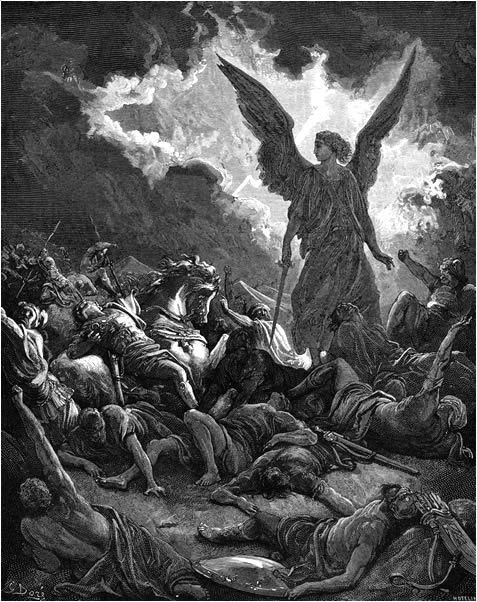
Then something happens.  What it is, is up for debate.  All we really know is that the army withdrew and some years later the Assyrian King was murdered by his own sons.  The Bible says the Lord sent an angel, “who destroyed every warrior, leader, and command in the camp of the Assyrian King” (v.21).  Sennacherib takes a stiff upper lip and records, “As for Hezekiah … like a caged bird I shut up in Jerusalem his royal city. I barricaded him with outposts, and exit from the gate of his city I made taboo for him.” [1] The Greek historian Herodotus, puts a completely different spin on the invasion.  He describes Sennacherib attacking the Egyptians, telling of a priest praying to their god and receiving this answer. “ ‘I shall send you champions,’ said the god. So, he trusted the vision, and together with those Egyptians who would follow him camped at Pelusium… Their enemies came there, too, and during the night were overrun by a horde of field mice that gnawed quivers and bows and the handles of shields, with the result that many were killed fleeing unarmed the next day.”[2] How many different truths are there are in one story!? 

Did God send an angel? Was it a plague of field mice? Did Egypt push Sennacherib back? Or was their turmoil in Assyria?  All of these are red herrings and miss the liberty God offers in this story.  Like the four blind men, we do not know the full picture in life.  We are blessed to have plausible deniability and see the world without God.  This is a freedom he has afforded us.  We can blindly feel our way around and grasp on to one truth.  Our blindness is a testimony to Gods love for us.  We do not live with the overwhelming presence of God forcing us to believe.  We are free to love him wholly, by own choice and that is beautiful. 


[1] Kalimi, Isaac, Sennacherib at the Gates of Jerusalem: Story, History and Historiography (p.38)

[2] Herodotus, The Histories Book II 141

Featured

Dad Devotional Day 21

hu·bris •ˈ(h)yo͞obrəs/ • noun – excessive pride or self-confidence

2 Chronicles 26

All sins are bad as they separate us from God.  A favorite Bible verse Christians love to cite, is Romans 3:23 “For all have sinned and fall short of the glory of God.”  Typically, when quoting this verse, they focus on the first half and de-emphasize the latter.  It is as though all sins are equal and damnation is a fait accompli.  Luckily for us, it’s not and in this unique story from Chronicles, we see how God establishes balance to this verse while correcting a man’s heart. 

It begins with a young king’s rise in the kingdom of Judah.  He is only sixteen years old, but is an able administrator and increases the power of his kingdom.  The king’s name is Uzziah and through his prowess on the battlefield “the Ammonites brought tribute to Uzziah, and his fame spread as far as the border of Egypt, because he had become very powerful” (v.9).  He built guard towers throughout the land and recruited the strongest men into his army.  Equipping them with the latest military armor and weapons, he is riding high on a wave of military success.  As the aphorism goes, it is the ‘pride before the fall’.

Desiring one thing more, the king succumbs to his pride and seeks the one thing he cannot have.  He wants to be God’s priest.  Like Adam and Eve in the Garden, he is given all that his eye can see with one command, not to eat from the tree of the knowledge of good and evil.  God alone has that knowledge and imparts it to His priest, of which Uzziah is not.  But, King Uzziah wants it and he is accustomed to getting his desires. 

Going to the temple, King Uzziah throws open the doors.  Seeing this, a large group of priests nearby follow him in.  In shocking effrontery, he grabs one of the golden incense plates and begins burning a sacrifice to the Lord.  One of the priests bravely speaks up saying, “That is for the priests, the descendants of Aaron, who have been consecrated to burn incense. Leave the sanctuary, for you have been unfaithful; and you will not be honored by the Lord God.” (v.18).  In this sacred space, the king violated the purity of the temple with his actions. 

In one of those wonderful old-world examples of justice, God shows up.  King Uzziah is furious at the priest for correcting him and instantly a contagious disease breaks out on his forehead. It is leprosy, one of the most contagious diseases in the ancient world.  The priests hurry the king from the temple and he struggles with the disease for the rest of his life.  The king’s pride was clouding his heart and his relationship with God.  In order for him to grow in the Glory of God, this pride must be removed from him.  

We may be great in one area, but our pride tells us we deserve more.  Pride is the sin from which all sins begin.  But rather than looking at sin negatively, we are be better served by seeking the Glory of God in the positive.  Like the king, we all struggle with pride, but we are all able to move closer to the Glory of God.  Falling short of the glory of God, means that God’s glory is something to strive for.  In a word it is holy

Featured

Dad Devotional Day 19

A Price to be Paid 

2 Chronicles 25

This is the Sunday School lesson of Jesus; He came and took all of the penalties due to us, because we are unable to pay these penalties ourselves.  Jesus is murdered in our place and enables us to go to heaven.  This, we are told is ultimate forgiveness.  What kind of forgiveness is this? Is the cross really a get out of jail free card?  Let’s look at a story from the ancient kingdom of Judah and shine a light on forgiveness.

A young king starts out as a decent leader, following the cultural laws set in place by Moses hundreds of years before.  He assumes the throne due to his father’s recent murder.  After finding the killers, he condemns them to death.  By all other cultural standards of the day, the murder’s family would also be put to death.  But this is not the common practice in Judah.  Moses established a new practice hundreds of years before, protecting the families of the accused and signified a break from surrounding cultures. 

Then one day, king goes to battle against his enemies.  In other cultures, it is accepted practice to hire mercenaries in order to augment your army.  The king has a large army, but in the famous words of Stalin, “quantity has a quality all its own.”  So, he hires more men from another kingdom.  The king veers away from his culture and follows the culture of other pagan kings.  The wonderful thing about a cultural norms are we all know when they are violated.  But it takes a uniquely strong individual to speak up when a leader violates them. 

As the king is preparing for battle, an average guy approaches him.  The scripture never records his name, instead only refers to him as a man of God.  He has the common sense of a grandfather and says, “Your Majesty, these troops from Israel must not march with you, for the Lord is not with Israel—not with any of the people of Ephraim. Even if you go and fight courageously in battle, God will overthrow you before the enemy, for God has the power to help or to overthrow” (2 Chron 25:7).  The king has already paid these mercenaries.  He is going to lose all of the money and make a bunch of greedy soldiers very irate.  He finds himself at odds with his own culture and has a choice to make. 

The king accepts the counsel and disbands the mercenaries. As anticipated, they are furious for losing the prospect of the spoils of war. On their return home, they attack town after town killing and looting as they go.  Three thousand civilians are murdered.  The price paid for inviting these men to the battle is enormous.  But the king wins his battle and kills many of his enemies.  The king is forgiven for breaking the culture God established in the kingdom.  Though he receives his victory, he still pays a price for making a choice against it. 

Christ actions on the cross are more than forgiveness.  They reestablish a and fulfill a culture we are meant to follow. God forgives our sins because of Christ’s sacrifice. But we play a part in this sacrifice.  Christ death and life are the culture we must seek to live in.  When we sin, we are living outside of His culture and we, like the king, pay a price for this choice.  Christ is not a ‘get out of jail free card’.  He is a green card, verifying our permanent residency in His culture.  Christ’s message on the Cross is; we are set apart and different from all other cultures.

Featured

Dad Devotional Day 18

2 Chronicles 21:12-20

The Hideous Inside

Our world today misses the color in ancient history.  Massive armies clashing against each other in hand to hand combat, prophets proclaiming unknown diseases sweeping through populations, are just a few of the examples.  In a world unlit by science and technology, the existential questions of an internal disease become purely spiritual.  Why would the god(s) allow a painful disease kill people?  What did they do to deserve this? All of these questions can be answered in the ancient world with one word, obedience.  If sacrifices and oblations are left undone, the gods get angry.  It’s a divine quid pro quo. 

The ancient Israelite and todays Christian uniquely struggle with this question.  We believe God is a God who loves us and wants the best for us.  We also believe that He is responsible for everything, including a disease that shows up out of nowhere.  How can two disparate ideas such as love and pain live in harmony? This huge question is outside our scope to fully develop, instead let’s focus on an example from the kingdom of Judah.

The year is 850 BCE and the fifth King of Israel assumed power by murdering his six brothers.  King Jehoram is fighting off raiders and busily setting up pagan temples.  One of the great heroes of the faith, the prophet Elijah notices sending the king an ominous message.  In it he says, “You have not followed the ways of your father…you have led Judah and the people of Jerusalem to prostitute themselves… murdered your own brothers, members of your own family, men who were better than you… You yourself will be very ill with a lingering disease of the bowels, until the disease causes your bowels to come out.” (2 Chronicle 21:12).  This disease lingers for two painful years before his insides fall out, killing him.  

On the surface, this sure seems like the pagan version of quid pro quo.  The king neglected God, thereby angering God and paying the price.  Which is the case, if we completely discount his soul.  That other half of us, which is sometimes overlooked.  The soul and the body operate as one. If our body is sick, then our soul can suffer too.  If our soul is sick, then our body can suffer.  We see this in the sick person angrily turning away from God and in stress removing years from our bodies.  God cares about the whole of us, our body and our soul. 

Before King Jehoram and the people became physically ill, they were already spiritually ill.  They were living their lives completely unaware of the spiritual disease growing inside of them.  Like a doctor’s x-ray, God uses the literal physical disease to show the people that spiritually their insides are diseased. The people’s souls are killing them. 

Christ describes himself as a physician sent to heal the sick.  He certainly does physically heal them, but He is not calling himself a doctor in the traditional sense.  Christ aims to heal the sickness of the soul.  Christ’s prescription is not a divine quid pro quo, Christ prescription is relationship.  Why bad things, happen is not the important question.  The question is when these things happen, are we considering our relationship with our creator? 

Featured

Dad Devotional Day 17

2 Chronicles 20

The Marching Band Takes the Field

We love underdogs—the guys with little chance attacking the game with all their might against impossible odds. It’s the Rudy Ruettiger or 1980 US Olympic Hockey team, encouraging us to strive for our dreams.  In short, we love hope.  What if the underdog is more than a long shot? The underdog has no shot.  Instead of sending out the football team, the coach makes the extreme choice to send out the marching band.  What happens when the marching band goes up against padded angry football players?

King Jehoshaphat of Judah finds himself in this predicament when multiple armies are marching against Israel.  A recent loss leaves his severely weakened forces with no way to defend his kingdom.  His devoutness and faith borders on extreme and would be considered negligence in any government today.  Turning to the only “arsenal” he has left, he begins preparing for spiritual warfare.  Beginning with an entire kingdom fast, then a huge corporate meeting for prayers and worship.  God’s response is a prophecy by one of the priestly families, telling the congregation, “You won’t be fighting in this battle. Take your stand, but stand still, and watch the Lord’s salvation on your behalf, Judah and Jerusalem! Never fear and never be discouraged. Go out to face them tomorrow, since the Lord is with you.’” (2 Chron 20:17).  This sounds ridiculous. Picture the White House’s Situation Room with all of the Security Council deliberating and the chaplain stands up assuring everyone God’s got this one!

The Kingdom of Judah believes this prophet. The following day, instead of sending out a bunch of soldiers, they send out the marching band.  The marching band strikes up a crowd favorite “Give thanks to the Lord, whose love endures forever” and immediately the opposing armies turn on each other! By the time the king’s people arrive to the battle site it’s awash in blood and carnage. Only the wagon trains full of loot are left.  It takes them a full three days to haul the spoils off and everyone is a bit freaked out. 

The takeaways are all over on this story.  We can easily point to the power of spiritual warfare and see how impactful they can be in our lives.  Fasting, prayer, corporate meetings, worship, and prophecy are all tools God uses to bring us closer to Him.  We can look at the Kingdom of Judah’s faithful obedience and apply it to our lives as well.  Every worship leader should use this story, trying to win an argument for more stage time! (Alright, maybe not.) All of these are solid lessons to be learned and applied to our lives.

This story shows us something more about God’s heart and explains why Christ hanging on the cross is called a victory.  God is not just the God of the long-shot; He is the God of the “no-shot.”  He showed the people of Judah that despite armies rising against them, and a victory would be seemingly impossible, He was there.  When the followers of Christ saw His limp body buried, all of their hopes of a Messiah were buried too. But God was still there.  In our life when your wife leaves you, when your child is sick, when you lose your job, God is there.  Our story of Judah is personified in Christ and his victory through death on the cross. 

I don’t know why God makes it so difficult at times.  What I do know, is when all that is left is the marching band, you send them out in full anthem to the field.

Featured

Dad Devotional Day 16

2 Chronicles 14-16

And again, I say unto you, it is easier for a camel to go through the eye of a needle, than for a rich man to enter into the kingdom of God. -Jesus

Matthew 19:24

This verse makes devout American Christians tremble and stay awake at night. How can anyone with a family, job, and life expect to be considered citizens of the Kingdom of God?  It doesn’t matter your income bracket; we all live in one of the wealthiest countries in history.  Three quarters of a million dollars in total assets places you in the top 1% of the world. If this amount of wealth still seems like a lot, only one hundred thousand dollars places you in the top 10%.  This verse appears to be the most damning verse of the Bible! Is there any hope for those born into the “lucky sperm club” of America?

A brief story may help.  The year is 900 BCE and a new king has ascended the throne of Judah.  King Asa inherited a kingdom recently ravaged by Egyptians and struggling in the tumultuous region.  Like most young men, he is full of vinegar and tears down all the pagan idols and begins fortifying his cities.  One day, a rider rushes into the court reporting a one-million-man army of Ethiopians are on the march against Judah.  This is over three times the force he can muster and additionally they have companies of charioteers with them.  This poor king’s only hope is to pray the Jewish version of ‘Hail-Mary’ and hope God shows up.  And He does. This victory sparks 30 years of peace and progress in the kingdom. 

Fast forward to the end of the King Asa’s life—he has done everything that a good king should do.  He has led his people wisely, increased wealth for the kingdom, and grown in diplomatic power.  So, when the rival northern kingdom of Israel marches against him, he leverages everything he has solving the problem.  He makes the ‘smart’ move, buying an alliance with a strong neighboring kingdom.  Through this alliance Israel is defeated.  God responds by sending a prophet chastising the king for relying on a pagan king rather than Him.  King Asa promptly throws the guy in prison and then dies of a foot disease, all the while refusing to turn to God. 

This man’s life is a living example of Jesus’ parable about the difficulties of wealth.  Wealth causes us to seek our own resources to save us.  It causes us to cease asking God for help and thereby we exclude ourselves from the kingdom of God.  Comparatively speaking, King Asa was always the richest man in the Kingdom, although at one point his heart was firmly fixed to God’s.  What really changed was Asa’s heart.  God never criticized wealth and neither does Christ.  Christ is not a communist or ascetic.  Christ is God in human flesh and He demands to be right in the middle of your life.  God’s message to King Asa was “The eyes of the Lord roam over the whole earth, to encourage those who are devoted to Him wholeheartedly.” (2 Chronicles 16:9). 

We all decide which eye to fix our gaze upon, a needle’s or God’s.

Featured

Dad Devotional Day 15

What do we know about God? Atheists deny His existence. Agnostics argue His existence is unknowable. Some Christians claim to know Him with certainty. All of these absolutist positions are wrong. The beauty of the Old Testament world is that everyone’s argument is closer to the truth than our world today. The ancients sought to describe the world around them through gods, each with their own opinions on how man is to live and behave. Every culture’s deity affected all areas of life and therefore consulted in decision making. Man sought counsel and god(s) responded. In short, it was a relationship. The argument was never whether your god exists or not, it was our god is bigger, stronger, and better than your god. Therefore, “truer” than yours.

In 2 Chronicles 13, the God of Abraham chooses sides between the divided Israelites. This story is fascinating because it directly addresses their view of God. Which means it addresses a facet of Christ we should understand.

In this story, there are two kings squaring off in battle. The new northern king, Jeroboam (the bad guy in the story) versus a young king in the south, Abijah. The good guys gather 400,000 ‘hand-picked’ warriors, while the bad guys muster twice that number. Abijah and his large army are surrounded on all sides by a massive army double its own strength. It’s looking pretty rough for the home team. So, what do the good guys do? Through Abijah’s mouth, the writer lays out his argument explaining his righteousness, ending in a scathing accusation, “God is with us; He is our leader. His priests with their trumpets will sound the battle cry against you. People of Israel, do not fight against the Lord, the God of your ancestors, for you will not succeed” (2 Chron 13:12). Instead of detailing all the gore of this battle, we are treated with one of the great understatements of the Bible, “Abijah and his people inflicted a severe defeat upon them; five hundred thousand picked men of Israel fell slain.”

If we are not careful, we can completely miss the point of the writer. The ancient world lived by a “might makes right” axiom. The writer turns this axiom on its head, telling everyone it is all wrong. He says in-fact right makes might! The truest God in the ancient world is making His claim that it is not the strength of His army justifying Him, rather His righteousness justifies the army.

How much do we know about God? It’s safe to say bluntly, not much. Why does God use the death of 500,000 people? Why does He take credit for the actions of man? There is a lot here we cannot answer, but we can see God addressing the cultural view of gods. He is showing the world His righteousness is stronger than massive armies assembled. A thousand years later a different king was asked about his power. Answering the question in the same way God answered Judah, Christ says, “My kingdom does not belong to this world. If my kingdom belonged to this world, my servants would fight to keep me from being handed over to the Jewish leaders. But for now, my kingdom is not from here.” (John 18:36). Christ’s sinless righteousness justifies Himself; He does not need armies to justify Him.

God’s message in consistent, whether 500,000 men die or one man. God in the Old Testament and Christ in the New are arguing the same point. It is not about the armies, it’s about righteousness and following Him. Right makes might, this is a gamechanger in ancient times, Christ’s time, and even our time.

Featured

Dad Devotional Day 14

2 Chronicles 10

Diving through the “Bible Belt,” one notices two flags flying in front almost every church. One is the classic Christian white flag with the field of blue and dove on it. The other is the stars and stripes of the USA. Flown at the same height and always with the same amount of reverence. We Americans love the USA because it is the bastion of freedom for world. Our founding fathers were almost all Christians and the right to religious freedom is etched upon our documents. These convictions are good and contribute to our culture, but our nation is not a nation of Christ followers. It is easy to dismiss our need for Him when our nation is strong.

Keep the United States in mind as Solomon’s house of stone is revealed to be built on a foundation of sand following his death. In 2 Chronicle 10–12 Solomon’s son Rehoboam takes over the throne. Disregarding the counsel of his father’s elders, this brash young man tells the leader of his work force “My father made your yoke heavy; I will make it even heavier. My father scourged you with whips; I will scourge you with scorpions.” (2 Chron. 10:14). The kingdom promptly splits into two separate countries with 10 of the tribes banding together under this ‘union’ leader, while only two tribes remain with the house of David and Jerusalem. In a span of two chapters, the kingdom as they know it falls apart. To make this rapid disintegration even more confusing, God claims this is His plan for the nation! God actually sent a prophet foretelling this actual event in 1 Kings 11:9. The new King Rehoboam makes a tragic political blunder and God claims it as His plan for the nation.

Let’s ask a hypothetical, if God did not split up the nation of Israel would they have turned back to him? They might have had the political strength to hold off Egypt in upcoming battles. They might even have been strong enough for the Babylonians. Their hard work and military power could have protected them from their fateful ending. God takes credit for splitting up the kingdom, because they turned away from Him. If he had not, would they ever turn back to him? Why would they? They would have a plausible argument that they did it all on their own and that God blessed them because they were strong. In short, they would be like all the other powerful countries in the world.

This is what brings us back home to one of the most powerful counties in the world. “God Bless the USA!” I love this phrase as much as the next red-blooded American. Many Christians place Israel a pedestal without really understanding their history. We should at least pause for a moment, and think critically about a nation that God actually does “bless”. Israel is blessed by God and it faces the full brunt of His blessing. God loves the nation of Israel too much to let it turn away from Him. Asking God to bless the USA is tantamount to treason if we mean it like Israel. Before wrapping the flag around the cross, we should think long and hard about what this means to God. When God blesses a country, He does not tolerate that country turning away from Him.

Featured

Dad Devotional Day 13

2 Chronicles 9

Solomon is known for two things. He is supposed to be ‘wicked’ smart and ‘wicked’ rich.  In US politics, he is the JFK of the old testament.  He was born into an aristocratic family and had the good fortune of being on the correct side of the most influential book ever written.  History has no choice but to place him in the winner column.  Is that really why we care? Do we read about Solomon because he has all the trappings of the world?

The Queen of Sheba certainly found it attracting.  From far away in her kingdom, she heard about this king who seems to have it all going on for him and came check him out.  She brought a whole bunch of gifts and swooned as Solomon “[mans]plained to her everything she asked about, and there was nothing so obscure that Solomon could not explain it to her” 2 Chron 9:2.  He kindly accepted all of her gifts and then because he could, returned the gesture in fold.  The queen, flushed, replied, “I did not believe the report until I came and saw with my own eyes that not even the half of your great wisdom has been told to me.” 9:6) Not only does Sheba stand in awe of Solomon and Israel, the whole world does! “And all the kings of the earth sought the presence of Solomon, to hear his wisdom, that God had put in his heart” 2 Chronicles 9:23.  This is part where we all put on our yarmulkes and start chanting “L’Chaim!”

In the famous words of Shakespeare, “The lady doth protest too much, methinks”[1].

The Queen of Sheba came because she did not believe all that God was doing.  She was blessed because she came to see.  Like all major ideas in the Hebrew Bible, Jesus takes them captive and transforms them to His own purpose.  Jesus is the new embodiment of all the greatness our Chronicles writer is trying so hard to convey about Solomon.  Jesus himself takes disbelief head on.  After Jesus’ tomb has been found empty and He appeared to two women, one of the disciples, Thomas, refuses to believe their story.  Later, in a locked room where all of the disciples were meeting, Jesus shows up and does the biblical version of a smack down on Thomas.  Thomas saw Jesus and believed he rose from the grave. Jesus said to him, “Have you come to believe because you have seen me? Blessed are those who have not seen and have believed.” (John 20:29). 

Here we have two stories about two different kingdoms.  One kingdom is dripping masculinity, like the bench press in a Gold’s Gym.  The other, affirming female testimony and showing Christ’s followers the blessings of believing and not seeing.  The message we should take away is the development between the two.  God takes our hearts from one kingdom that loves hyper-masculinity, riches, and wisdom and moves it to a place that loves Him.  We read these stories, laughing and making fun of the farse of Solomon’s absurdity.  But in the end, we must realize that the story is about us.  Our lives are a sad parody until Jesus shows up and we follow Him, not because we see, but because we believe. 


[1] Hamlet, By Shakespeare

Featured

Dad Devotional Day 12

Most good stories begin at night. In a quiet dark corner with hushed voices discussing the terms of some agreement. One offers to do a favor in return for something else. The terms are agreed upon and they separate as if they never were there. In the light of day, the world awakens and gets to work. Our story is just like this.

On a dark night, King Solomon has a vision discussing terms with God about ruling his kingdom. As dawn breaks, Solomon begins on God’s great temple. He imports fine wood, precious metals, and jewels for the building. All of the work is described in great detail, with gold pomegranates on chains, giant gold angels, and ornate stone work . When the day of dedication finally arrives, this new structure inspires splendor and awe in the assembled masses. Everyone’s hopes are high that something huge is going to happen. A procession of finely dressed priest leads the Ark of the Covenant to its final holy resting place between two massive golden angels and that is when stuff starts to get real. Smoke slowly begins to build around the Ark as one priest looks at another. Then smoke begins to pour out of every corner of the temple and the priest are tripping over each other to escape.

King Solomon climbs up the steps and gives an impassioned prayer crying out to God. As his voice hits a dramatic climax yelling “Lord God, do not reject the plea of your anointed, remember the devotion of David, your servant”, the skies crack. Fire rips down to consume the prepared offering. (Everyone poops their pants.) For seven days they slaughter 144,000 oxen and sheep at a rate of 14 per min. You can’t kill these animals fast enough! And then its over… Everyone goes home and back to their lives.

Sometime later, Solomon is sleeping during the evening and God comes to him in a vision. God lays out the promise He made with Moses and David one more time. And then He makes a curious comment. He leaves Solomon with a prophetic image. This brand-new temple God just smoked out is going to be destroyed, “because they abandoned the Lord, the God of their ancestors, who brought them out of the land of Egypt, and they embraced other gods, bowing down to them and serving them. That is why he has brought upon them all this evil.” (2 Chronicles 7:22) This whole endevore began with a conversation with God and that’s how it ends.

How can this be? If we had an event in our history where a building started smoking, fire came down from heaven, and the nation went on a non-stop seven-day psycho butcherfest; wouldn’t we make it national priority one not to screw with God? In the 500 years from the dedication to the destruction people clearly forgot about priorities. The writer is making a case from the beginning to the end that this is a two-way street. Follow God and He shows up, don’t and He doesn’t. The point is turn back to God.

This is not the place to dig into deep theology about God bringing evil on Israel. Old school is the best school not because it’s easy to understand, it’s the best because of brutal truths. You and I are not God. The point is simple; if you are far from God, turn back to him. You may be mad or confused, but you are at least going in the right direction.

Featured

Dad Devotional Day 11

2 Chronicles 1

When I was in college, one of the buildings had the words “Wisdom is the principal thing; therefore, get wisdom” inscribed high on a main entry way. I remember liking it because as a public university it recalled a time when universities did not look at the church with defensive animosity. Today, those words chiseled into the building are safe only because no one recognizes them as Proverbs 4:7.

Most people know two stories about Solomon, one God came to him and told him he could have anything he wanted. When he asked for wisdom, God was so pleased He gave him everything else in addition to wisdom. The second is the baby chopping story to discern the true mother. (If you have no idea what I am talking about don’t worry we will get to it at another time.) The point is always Solomon’s wisdom and talents as an administrator far surpassed everyone else. Solomon was a great king and it is easy to identify him as someone to emulate and seek wisdom.

Wisdom is great. Plato, Socrates, and Confucius all made wisdom a pinnacle of their teachings. The problem is the Bible is not a wisdom book, it is a relationship book. It is a book that describes our relationship to God and vice versa. With this in mind what, why is God so pleased that Solomon asked for wisdom? Solomon is a young king and has a huge kingdom to administer. He is asking God to help him in his new job. Wisdom being the main tool for the job. God is pleased, not because he asked for wisdom specifically, but because he wanted to serve his kingdom well. Solomon is asking to enhance his relationship with his people and the people relationship with God.

Christians can be confused by all the entrapments of the world; lusting for wisdom and knowledge is no different. God calls us to care about people around us, not wisdom. The Bible has a whole section entitled wisdom literature, which is actually longer than the gospels. This does not mean that wisdom is more important. It means that our wisdom is different from other people. Our wisdom can be summed up in one verse, Proverbs 10:9 The fear of the Lord is the beginning of wisdom, and knowledge of the Holy One is understanding. Our relationship with God is the beginning of wisdom and everything else flows from it. Solomon understood this and was blessed. Put God first in your life and you will be as well.

Ironically, if you followed the directions of that verse on the University’s building you would do a U-turn and go to church. I don’t know if that’s what they intended…

Featured

Dad Devotional Day 10

1 Chronicles 29

If you had to choose for the rest world one event that defines America history which would you choose? Would it be the signing of the Declaration of Independence, the storming of the beaches of Normandy, or might it be landing a man on the moon? This is the same question posed by the writer of Chronicles. For him, there was only one clear choice: The Temple.

For five hundred years from 1000BCE-500BCE, the Temple in the City of David made the Jewish people unique in their eyes and in the eyes of God. After its destruction, our writer is living as an exile in a foreign country, present-day Iraq. The founding of first Temple and our writer are actually separated by 500 years. Did you catch that? He is describing in great detail speeches uttered and resources gathered all the while being removed from the event by half a millennium and over 650 miles, in a world lit by animal dung! This is like a 2020 Catholic in the Bronx raving about the party thrown at the St. Peter’s Basilica groundbreaking.

We can look at Chronicles in one of two major ways. One, we can see it as something so huge and impactful that 500 years after the fact, the people are still talking about it. This certainly could be the case. After all we believe this is the first time in human history the true living God actually had a temple built by man. Or two, we can take it to mean something more. It is a beacon calling the Jewish people to God. He is writing to Jews all over the ancient world, who have forgotten what it means to be Jewish. A nation set aside for God. A nation with an identity different from the pagan culture surrounding it.

The Temple is like a lighthouse to a ship on dark night. It does not tell you where to go, but it keeps you from crashing into the land. As Christians, we can do well to respect this and look to Jesus the same way. He does not always tell you where to go or show the path is in front of you. But, when you are lost out at sea, the light house is a beacon of hope. It functions as guidance only to the extent that it shows the boundary of land. The Temple and Jesus remind us that we are different from the rest of the world, we are God’s people.

All of America will die away someday. The cities and towns we love will change and might be gone. The first temple lasted a staggering 500 years, but even it was eventually destroyed. If the writer of Chronicles is so passionate about this event, how much more should we be, having Christ as a living temple, that will never be lost.

Featured

Dad Devotional Day 9

1 Chronicles 28

It’s always bothered me that Jesus only did his ministry for three years. This is supposed to be the most pivotal event in all human history and the main character is only on stage for three years. Imagine if Steven Spielberg wrote Saving Private Ryan like this. You sit through an hour and a half of war, blood, and drama only to finally rescue Private Ryan and he takes a bullet to the head. Movie credits. It would be terrible! Yet in Gods cosmic movie this is basically what He does. He has two millennia of build-up to this Messiah character and when He finally arrives on set, he is gunned down before any of the real story happens. What the heck God?

Reading 1 Chronicles 28 might give us a small amount of understanding. The scene is this. David is at the end of his life and the pressure of death is leading him to amass supplies needed to build the temple. There are huge quantity of stones, gold, silver, and bronze. The plans are drawn and the builders are ready. David is handing Solomon everything he needs to build the temple. All he has to do it assemble it. The message is clear, this is a big deal and Solomon is going to build it.

How does any of this relate to Jesus? Well before Jesus was the Messiah, He was the prophet. This is how His followers saw Him and how He behaved. This behavior was His main means of communication. A prophet not only tells the word of God, he literally acts out the word of God. Knowing this, it is not hard to understand why Peter quoted psalm 118:22 “The stone the builders rejected has become the cornerstone” in describing Jesus. The life Jesus led prepared the way for a new temple. He lived His ministry preaching in the physical temple, but to the prophet Jesus, He was living example showing how the Temple is much, much more. This is why Jesus answered the temple leaders cryptically saying, “Destroy this temple, and I will raise it again in three days” (John 2:19). Jesus lived all of His life as a live action play communicating God’s will for his people.

(Dad-You took one confusing idea and answered it with another confusing idea. Thanks)

So, let’s look at this. David does all of the work collecting up the resources needed to build the temple. The people are all assembled for him and Solomon can begin doing the work. Jesus likewise does all of the work assembling the people, demonstrating their resources, telling them about this “counselor” who is going to help them. Just as when David teed up Solomon, Christ is teeing up His church. He is not going to do it for them, they are going to do it themselves. He is demonstrating at the end of His short ministry that they are going to build the Temple. They are going to build His Church. They are the place that God will dwell just as He did in Solomon’s temple. To the very end of His life on Earth, Christ lived out the movie scene with a precision that makes you walk away saying, “I get it now”.

It will always bother me that Jesus had such a short time preaching. Nor did He didn’t write anything down. It all just seems so unfair. But He left us all the tools needed to build the kingdom and we get to make our mark on the kingdom. For that I am grateful.

Featured

Dad Devotional Day 8

1 Chronicles 22–28

Jewish writing has a long tradition of internal debate and seeking truths within the same story. Our writer in Chronicles is writing to an exiled Jewish audience in Babylon. He is making a patriotic plea for the people to return to Israel by telling the same story already told in Samuel and 1 & 2 Kings. His retelling of this story brings new color, because he is writing for completely different reasons. If you merely read through Chronicles without this comparison in mind, the beauty of the story is lost.

In 1 Chronicles 22:5, the author begins with David saying, “My son Solomon is young and inexperienced; but the house that is to be built for the Lord must be made so magnificent that it will be renowned and glorious in all lands. Therefore, I will make preparations for it.” Conversely, in 1 Kings 2:3, there is only personal instructions to Solomon: “Be strong and be a Man! Keep the mandates of the Lord, your God, walking in his ways”. Why does Chronicles care so much about building this house? The answer may lie in the chapters following.

Chronicles devotes five long chapters listing the jobs conducted in the execution of this new house and specifically, who is going to do them. Each family is listed by name. Some have a short lineage, going back to Joseph or Moses or Aaron. The focus is on the people supporting this new national project. The author is writing a story his audience already knows, but he is telling them that they are a part of the story in a way not told before. He is telling the exiled Jewish people; they all have a place in this great project. This was not a royal temple built by a king, but rather it was their temple, built by the God of Abraham.

In the new testament, Paul communicates this idea of one people working towards a common purpose in 1Corinthians 12:12, “Just as a body, though one, has many parts, but all its many parts form one body, so it is with Christ.” Paul is not making this idea up. Nor is it anything new to Jewish teachings. Christ has one Church and one people working for one purpose. Your vocation matters not if you are in Christ, you are part of Christ’s temple project. Jesus’s story is a retelling of the Jewish story, but He tells it in a way we have never heard before. And that is beautiful.

Featured

Dad Devotional Day 7

Matthew 7:24

In preparation for the upcoming Temple our current 1 Chronicles story line, I decided to jump ahead to a bit of foundation talk by Jesus.

In Matthew 7, Jesus harnesses his background as a laborer. He illustrates a building project and likens it to having a good moral foundation in your life…. Just kidding. That’s not what Jesus is talking about at all, but the number of sermons to the contrary make my head spin. (A good rule of thumb is to assume Jesus is always talking about something other than what you think he is talking about.)

A little context is helpful. The period in which Jesus is preaching, a massive overhaul of the Temple complex has been completed with the finishing touches ongoing. This is the defining new symbol of the Jewish people. Herod, the local king, has managed to appease Rome by keeping the locals happy with this ornate undertaking. All of the people are very proud of this national building project.

Jesus tells this parable about a builder who builds his rock on the sand as opposed to one who builds his house on rock. The builder who builds his house on rock, is the one who listens to Jesus and acts on his words. The man who builds his house on sand is the man who listens to Jesus, but does not do what he says. When rough weather comes the house collapses.

Jesus is staking a claim against this new fancy temple the people are looking to. He is saying in not so many words that this national identity in the temple is not the way for Gods people to live. It will lead to trouble and ruin for them. (As it has in the past.) Instead, He is offering a different path that will endure in times of trouble. At the same time, He is admonishing them for merely listening to Him. He is telling them to get their back-end in gear or Rome is going to crush you. The difference between success and failure in His Kingdom is action.

The closing lines, “the crowds were amazed at his teaching, for he taught them as one having authority, and not as their scribes” are perfect. Partly, because they are as confusing as the rest of the parable, but more precisely because they reflect the sentiment of the audience. Jesus is stomping on their version of the Statue of Liberty and they are amazed at Him in the same way your mother would be if you came home cursing like a sailor.

Jesus is saying that He is foundational and is not about politics. He expects his people to follow Him through actions. By doing so Israel’s foundation will stand when the rough times come. It is an extraordinary claim made in an extraordinary time. But the people are not. We are just like them, if not more so. Jesus is calling your life to be one not about politics, or national identity, but a life about him. A person who acts in response to his call is going to weather the storm when it comes. Is that you?

Featured

Dad Devotional Day 6

1 Chronicles 21

Part II

Which is better — to be in fear or to be safe? Most people would argue safe. They point to Maslow’s Hierarchy of Needs and say things like, “We advance as a society, if we are safe”. These days the parting phrase ‘stay safe’ is on everyone’s lips. And FDR’s famous line, “the only thing we have to fear, is fear itself” just feels good, doesn’t it? The problem is God disagrees with all of them. King David learned this lesson personally.

In the first half of this story, we see how God impacts His people on a corporate level. But in the second half, God gets personal. He sends a vision to David of an angel of death standing between heaven and earth, the angel’s sword drawn over Jerusalem. David is commanded to go to a threshing floor, buy it with his own money, and give a sacrifice to God. The owner, Ornan, offers to give it to him, but David refuses and instead pays an exorbitant fee. After making the appropriate offerings the angel returns his sword to the sheath. Interestingly, the story ends not with David being happy to have saved a bunch of lives, but instead refusing to go near the presence of God.

David literally had the fear of the Lord put into him. This fear was missing from him earlier, when he commanded the census be taken of Israel and it cost him dearly. David had not realized how dangerous God could be. He had turned God into the lamb version of Christ. You know him, “nice guy” Jesus who loves everyone and everything. Completely ignoring the Lion of Judah, who refuses to give an inch of righteousness. Nothing about God is safe, He makes no promises to be safe and its not really in His “DNA”. Instinctively, we don’t like this. But He is good and fear is an appropriate feeling when dealing with God’s goodness. Fear keeps us on our guard, it heightens our senses, it makes us forget everything superfluous. Fear makes us listen. Fear makes us move!

Conversely, safe makes you stay put. Safe homes shelter you from the storm. Safe jobs keep you from looking for the next one. Safe keep us from growing. We sit in safe’s inviting embrace and are happy, like a child not wanting to change a diaper. It may smell bad, but it’s mine and it’s warm.

God wants us to grow. More than anything, He wants us to grow in a relationship with Him. Our greatest fear and the greatest movement should be in our dealings with Him. Our safety is something He cannot abide. He went to great lengths to make David move. Embrace a fear of the Lord and everything else will start moving in your life.

Featured

Dad Devotional Day 5

1 Chronicles 21

Part I

When do you know that something belongs to you? Instinctively, we would all respond with a “yes” to something that is under your roof, in your bank account, or even has your name scribbled on it. How about your family, do they belong to you? God sees this question of belonging differently. In 1 Chronicles 21, God’s jealousy is on full display and goes to great lengths asserting His claim. God’s view is difficult for modern minds to comprehend.

In chapter 21, King David orders a census to be taken of the nation. David’s number two man, Joab, warns him that guilt would be brought on Israel if he goes through with the census. But as King, his command stands, and he doesn’t back down. Joab takes a census of the people. Almost immediately, David realizes he is in trouble and has acted foolishly. A prophet named Gad comes to him and lays down three options: 1. Famine for three years. 2. Three months running from your enemies. 3. Three days of plague.

(Seriously God! Your going to kill a bunch of people over a census!!??)

In our minds, a king taking a census is a perfectly normal act. But that is not how God sees it. In the second year of the Exodus, it was God Himself who counted the people of Israel (Numbers 1) He did this because they are His. Even this was done with a great amount of trepidation; God instructed the people of Israel to provide a national sacrifice to Him as part of the census (Exodus 31:11). No matter how large the nation of Israel grew, they would always know they are His.

Now how does this relate to King David’s census? David’s act of taking a census claims ownership of something not his! He was not taking a census to honor God. He was taking a census to promote himself. Now, think about your family. If you are in Christ’s Kingdom, your family is not yours. Your family belongs to God and you should treat it as such. It means that as a father, God is entrusting you to teach, love, and care for His people. It is a very high calling God does not take lightly.

To David’s credit, he realizes his mess and chooses the best option available. Famine comes from nature, enemies are men, but plague is from God. He throws himself at the Lord’s mercy and prays for a quick end to the sickness. Like all fathers, our anger can burn hot fast, but the repentance of a child cools it just as quickly.

Nothing fixes a child like an appropriate spanking and God’s spanking fixed David good.

Featured

Dad Devotional Day 4

1 Chronicles 20:2 David took the crown of Milcom from the idols head. It was found to weigh a talent of gold with precious stones on it; this crown David wore on his own head.

Sometimes the Bible is a blessing and it just speaks to you other times its a curse. You sit there in oppressive silence. There are times we do not know who the author is writing to, or the world view in their mind. But, it is safe to assume they writing for more than entertainment. So digging is required. This passage did this for me. Luckily, the parallel text in Samuel shows the scandalous context all of Israel was whispering about.

Chapter 20 begins, “At the turn of the year, when kings go out to war, Joab, led the army out in force”. David stays back home to get a little sugar when he should be out with the troops. The writer of chronicles does not mention this, instead he gives us the insight into David’s heart and mind through his actions. David lets his top man, Joab, fight the battle and then arrives to remove the defeated king’s crown off the idol’s head, placing it on his own. You can almost feel tension 2500 years later. David shows up after all the fighting is over, stealing a poor soldiers wife, murdering him, and grabs the fanciest treasure off a pagan idols head. Everyone’s eyes have to be rolling as this guy takes the place of the idol. That’s nerve all right.

You might call this ‘the pride before the fall’, or as Voltaire wrote, “History is filled with the sound of silken slippers going downstairs and wooden shoes coming up.” God is getting ready to drop the hammer on David and we wise to learn from his lesson. No matter how much we achieve in life, a leader can never forget the men who fight beside him. And when your ego grows to the size of a demigod, it’s a good sign it’s too big. There is only one true God and when we make an idol of ourselves his love for us will not tolerate it. David took a crown of gold and is pulled down by God, while Christ took a crown of thorns and is raised up. Which do you seek?

Featured

Dad Devotional Day 3

1 Chronicles 19

What does it mean to be “Old School”? The question itself conjures up many great aspects of manhood and in 1 Chronicles 19; David exerts himself in sweet old school fashion. The story begins with David sending out some messengers to congratulate a new king on his assentation to the throne. The new king, fearing that these ambassadors are spies, shaves their beard and returns them with half their garments cut away. And its not the cool ‘Top Gun volley ball’ half that is removed. Now picture this. These are strong warrior men, for whom growing a beard is the symbol of their masculinity. They are sent back shaved with their twigs and berries swinging in the wind for all to see. Dang Bible!

Old school demands respect and old school does not tolerate bullies. How can an old school guy like David, with a heart for God, reassert a mans masculinity. He could send a small army and conduct a long siege slowly wearing down the enemy. He could weakly send out a negotiating party and explain right and wrong telling them to apologize. Or he can send a all his army and act swiftly. Men are going to die either way in war. That is the nature of it. The question a man after God’s own heart must ask is, which one looses the least lives and restores the identity stolen from these men.

We deal with this all the time. Do we face a bully on the playground and punch him hard in the nose or do we slowly try convince him he is wrong? The swift and hard way may look extreme, but if you wait many kids will be hurt in the delay. There is going to be blood either way. Sometimes, a quick bloodbath is exactly what God’s heart wants, because the alternative is even more painful. David is not going to let his men be stripped of their identity and neither should you. God made you with a unique identity and its worth going to war for. Go and fight for it!

Featured

Dad Devotional Day 2

(This is a throwback to earlier in our place in the Bible. But it is obscure and the story is weird.)

Genesis 6:1–4 When human beings began to grow numerous on the earth and daughters were born to them, the sons of God saw how beautiful the daughters of human beings were, and so they took for their wives whomever they pleased. Then the Lord said: My spirit shall not remain in human beings forever, because they are only flesh. Their days shall comprise one hundred and twenty years. The Nephilim appeared on earth in those days, as well as later, after the sons of God had intercourse with the daughters of human beings, who bore them sons. They were the heroes of old, the men of renown.

The amazing part of the Bible is how weird and wonderful it can be at the same time. Today, we live in our tech world and it’s hard to place parts of the Bible into our modern mind. Do you believe in witches or giants? Of course not. But have you seen Harry Potter or the Lord of the Rings? They certainly exist there don’t they? Yes, yes but that is not the same thing. We separate these in our mind from the fictional to the non-fictional.

But, what if you did not separate them in your mind? What if your culture had no “Enlightenment” and you constantly wondered about stories told around the campfire? How could your God permit these creatures to exist? It does not matter if they are fact or fiction; they are real in your mind. If the battle you are going into is against men of unusual size and skill. How could you possible win if you thought these men had god DNA? Science can not change your mind since fear has a hold of it.

This story is one of context, that forces us to put our minds in our ‘primitive’ state. God is telling the people of Israel that He is Lord of their nightmares too. The stories that keep little children up at night and the fear soldiers feel on the battlefield. He is Lord over these stories and fears as well. He speaks to our irrational fears and says, “Yeah, see those tough guys we are going up against in battle, I made them too. Now win!”. He literally and literarily takes all thoughts captive.

Featured

Dad Devotional Day 1

1 Chronicles 17 Nathans Oracle

David has a desire in his heart to do something great. He wants to build the temple for God and the Ark of the Covenant. After receiving the go ahead from Nathan, I am sure he had to be pumped. He has all of the political backing and his recent treaty with Hiram made it possible for him to get the supplies needed. But during the night God comes to Nathan and tells him that David is not going to be the one to build the temple. Instead one of David’s sons is going to do this. There is no blame in Chronicles for David’s warrior-ness or blood on his hands. Instead, we see how God magnifies David through his son just as the God of Abraham will be magnified by His son.

Let me explain:

You want to be a major league baseball player. That is a great goal and one I support as your dad. So, we can say that it is our goal to have a Glotfelty in the MLB. It would be a great thing if I could be a MLB player. It would be sweet and we would have an amazing life. But, if you become a MLB player, now I get to be the father of a son who saw a dream and helped him to achieve it. A Glotfelty is in the MLB! Now I am proud to see you play and we both achieved our goal. I am not less because you did it. I am more.

Therefore David is not less because he does not build the temple, he is more. He is honored to have his name do something great which he wanted to do. In the same way God sends His son Jesus. God is showing His people a new level of his greatness. He was already esteemed by the nation of Israel, but God the Father does not save his people. He leaves that to His Son. This does not lessen God the Father; it is makes Him even greater than they had previously understood. When they are both working for the same goal; a son always increases the father’s honor.