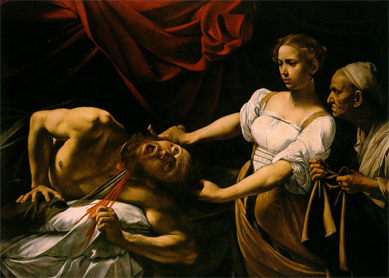
Judith
My son and I are reading the story of Judith. This short novella is famous from the many paintings and sculptures of the beautiful heroine depicted in the act of cutting off the villain’s head or triumphantly carrying her trophy. The wonderful story begins in a little mountain town on the outskirts of Israel standing against the undefeated Assyrian army. As their food and water supplies dwindle, so too does the people’s hope, and they convince their city leaders to capitulate in five days. Into this scene, a beautiful rich widow contrives a scheme to rescue the town and save the rest of Israel.
Leaving the town, she descends to the encamped army in her “going out clothes” looking for the man in charge. She tells a bold face lie to the Assyrian general about her defection, desire to aid his army, and begins seducing him. On the night when the general plans to “ahem,” Judith removes his sword and cuts off his head while he is passed out drunk. The rest of the story is boiler plate murdered armies and victorious Israel. Wonderful children’s story, thanks, Bible…
We are not the kind of family which typically has issues discussing sex and bloodshed in the Bible. These elements are part of our human story. But what about the bold-faced lie and deception? What about violating number eight (false witness) and number five (murder) of the Ten Commandments? How do I lionize this heroine in light of her deceit?
Lest, I castigate Judith alone, there are many examples of females lying to save lives in the Bible. Sarah lies to Pharaoh about her marriage, the Hebrew midwives deceive the Egyptians about birthing male children, and Rahab lies to protect spies in Jericho just to name a few. Each of these stories has a clear life and death consequence to telling the truth and each time life takes precedence. Which is a great lesson to learn when Nazi’s SS bangs on the door asking if we are hiding Jews in the attic? But maybe something is going on here and maybe a lifeline to fathers seeking to instill Christian values in their children.
This search brings us to a key question: What to do when a choice must be made between two sins? Lie and murder to save life or tell the truth and be an accomplice to murder. This conflict is a clashing spark that illuminates the darkness of our understanding. The world is a muddy place and as comfortable as black and white moral questions are, there is a vast spectrum of greyness we live in.
Christ arrived into a world struggling to answer this question. The religious leaders elevated the Law to God status while the disciples faced the danger of disregarding law all together. Both approaches are logical opposites of the same fallacy. Christ tells us in Matthew 5:17, “Do not think that I have come to abolish the law or the prophets. I have come not to abolish but to fulfill.” Christ is inserting himself right in the middle between His followers and the scripture. We must place all of the scripture in its proper place relative to Christ. Only then can we actually have, “righteousness [that] surpasses that of the scribes and Pharisees, [and] enter into the kingdom of heaven” (v.20).
Christ does not free us from obligations to follow the scripture, but the scripture only makes sense when we look at it in entirely with Him. Judith is a heroine, because she understood that the Ten Commandments show us God more clearly, but they are not God.
Is Judith a children’s story? That’s up to you to decide, but where else can you read about war, lying, seduction, and murder and it only makes sense because of Jesus? And that is the essence of a children’s story. Thanks, Bible.
 Dad Devotional
“Judith is a heroine, because she understood that the Ten Commandments show us God more clearly, but they are not God.”
That’s a thinker. Thanks, Phil.
LikeLike