Plausible Deniability
Chronicles 32
There is an ancient Buddhist parable about four blind men learning of an animal called an elephant. Upon finding one, they rub their hands over it and describe the animal. One feels the tusk, claiming an elephant is long and smooth. Another rubs the animal’s sides and declares the animal is like a rough wall. The third, grabbing the elephant’s tail, argues that an elephant is like a rope. The last one, feeling the ear, says they are all wrong and rather it is like a large fan. This parable has been told for over 2500 years and is still is true today.
A history from the Judean Kingdom brings this parable into full living color. Sometime in the year 701 BCE, the powerful Neo-Assyrians King Sennacherib, invades and captures the northern kingdom of Israel. This brings him to Jerusalem’s doorstep, who finds herself without the military power to repel the invaders. King Hezekiah, the Judean King, commands his people to prepare for a long siege by routing a small river’s flow under the city walls. He also stops up all of the wells in the region, leaving little water available for the invading army. Then, they pray, “Be strong and courageous. Do not be afraid or discouraged because of the king of Assyria and the vast army with him, for there is a greater power with us than with him. With him is only the arm of flesh, but with us is the Lord our God to help us and to fight our battles” (vv. 7-8).
The Assyrian forces are undaunted and begin to taunt the Judeans. Every day, they send men to the city’s walls hurling insults instead of rocks. Citing all of their previous victories, they yell out, “Were the gods of the nations in those lands able to rescue their lands from my hands?” (v.13). They constantly compare the God of Israel to gods of other defeated nations. But Hezekiah and the people’s faith holds fast and they pray even more.
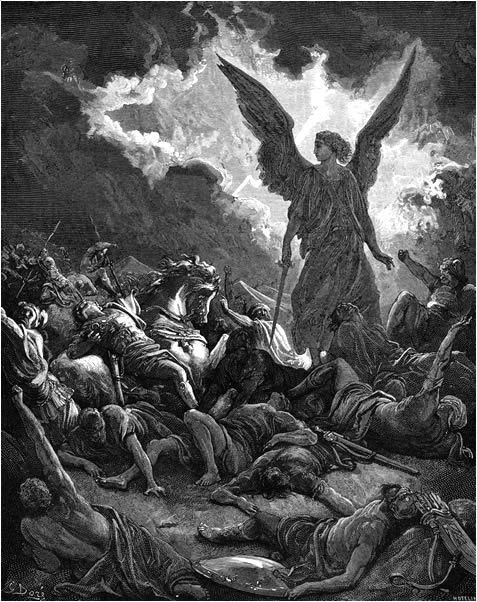
Then something happens. What it is, is up for debate. All we really know is that the army withdrew and some years later the Assyrian King was murdered by his own sons. The Bible says the Lord sent an angel, “who destroyed every warrior, leader, and command in the camp of the Assyrian King” (v.21). Sennacherib takes a stiff upper lip and records, “As for Hezekiah … like a caged bird I shut up in Jerusalem his royal city. I barricaded him with outposts, and exit from the gate of his city I made taboo for him.” [1] The Greek historian Herodotus, puts a completely different spin on the invasion. He describes Sennacherib attacking the Egyptians, telling of a priest praying to their god and receiving this answer. “ ‘I shall send you champions,’ said the god. So, he trusted the vision, and together with those Egyptians who would follow him camped at Pelusium… Their enemies came there, too, and during the night were overrun by a horde of field mice that gnawed quivers and bows and the handles of shields, with the result that many were killed fleeing unarmed the next day.”[2] How many different truths are there are in one story!?
Did God send an angel? Was it a plague of field mice? Did Egypt push Sennacherib back? Or was their turmoil in Assyria? All of these are red herrings and miss the liberty God offers in this story. Like the four blind men, we do not know the full picture in life. We are blessed to have plausible deniability and see the world without God. This is a freedom he has afforded us. We can blindly feel our way around and grasp on to one truth. Our blindness is a testimony to Gods love for us. We do not live with the overwhelming presence of God forcing us to believe. We are free to love him wholly, by own choice and that is beautiful.
[1] Kalimi, Isaac, Sennacherib at the Gates of Jerusalem: Story, History and Historiography (p.38)
[2] Herodotus, The Histories Book II 141
 Dad Devotional